
Słuchaj tego podcastu za darmo w aplikacji: Pobierz za darmo z App Store
radio.pl
Sleep timer
Zapisz stacje
100 odcinków
How Plants Evolved to Exploit Humanity with Dr. Robert Spengler
02.11.2026 | 50 min.Did humans domesticate plants, or did plants domesticate us? Paleoethnobotanist Dr. Robert Spengler joins Dr. Cassandra Quave to explain why ancient farmers likely had no idea they were changing the course of evolution. Key traits like the tough rachis in wheat and barley took 2,000 to 3,000 years to take hold, far longer than any one person, or any one generation, could have planned for.
From there, they follow the Silk Road, which Dr. Spengler describes as the spokes of a wagon wheel with Central Asia at the center. They cover millet and wheat crossing Eurasia, apples hybridized by bees and locked in by grafting, and chickens that spread across the ancient world once they began laying eggs year-round. They also cover spices and early cannabis burning, medieval barley farming in the Gobi, and why bugs were probably a normal part of the ancient menu.
Dr. Spengler directs the Fruits of Eurasia: Domestication and Dispersal project and oversees the paleoethnobotany laboratory at the Max Planck Institute of Geoanthropology. He is the author of Nature’s Greatest Success: How Plants Evolved to Exploit Humanity and Fruit from the Sands: The Silk Road Origins of the Food We Eat.
Learn more about his work at https://www.spenglerlab.com/
#FoodiePharmacology #Paleoethnobotany #Archaeobotany #PlantDomestication #SilkRoad #AncientFoods #Ethnobotany #FoodHistory #ApplesThe End of Cheap Food with Kristine Root
26.10.2026 | 47 min.Why does “cheap” food cost us so much? In this episode of Foodie Pharmacology, Dr. Cassandra Quave talks with Kristine Root, founder of the branding and growth marketing agency Socha, about her new report, The End of Cheap Food. Kristine traces how U.S. farm policy and an all-out push for efficiency built a food system that looks inexpensive at the register. Along the way, the real costs moved into our healthcare systems, our soil, and our farmers’ livelihoods.
They dig into how what we grow and how we grow it shape the nutrition on our plates, from heirloom tomatoes to regeneratively raised beef. They also ask why a perfect-looking strawberry can leave us unsatisfied. Then they turn to marketing, and how transparency, a three-second hook, and a deeper story can help people choose foods that are better for their health and the planet. Along the way they cover beans as the next marketing hero, teaching kids to cook, food as medicine, and what it would take for the highest-quality food to also be the most accessible.
Read the free report, The End of Cheap Food: https://www.sochabranding.com/the-end-of-cheap-food-2026-report
#FoodiePharmacology #EndOfCheapFood #FoodSystems #RegenerativeAgriculture #SoilHealth #NutrientDensity #FoodMarketing #FoodAsMedicineMicrobes for Sustainable Agriculture with Dr. Mariangela Hungria
19.10.2026 | 48 min.Can bacteria be bred to feed crops, and do it for a fraction of the cost of chemical fertilizer? This week on the show, Dr. Cassandra Quave talks with Dr. Mariangela Hungria, a soil microbiologist at Embrapa (the Brazilian Agricultural Research Corporation), 2025 World Food Prize laureate, and one of TIME’s 100 Most Influential People of 2026. They discuss how nitrogen-fixing bacteria partner with legumes, grasses, and sugarcane, and why chemical fertilizers added to the soil drive water pollution and greenhouse gas emissions.
Dr. Hungria explains how her work with soybeans helped make Brazil a global leader in agricultural biologicals. She shares field-trial results, the economic and climate savings, and what it takes to bring beneficial microbes to crops like tomatoes and potatoes.
They also cover restoring degraded pastures, bacteria that help crops tolerate drought, and why synthetic microbial communities are still hard to build. Dr. Hungria’s message is that biologicals can already replace much of the chemical input in farming, and that they can work in conventional and organic agriculture.
#SustainableAgriculture #SoilHealth #SoilMicrobiome #NitrogenFixation #Biologicals #RegenerativeAgriculture #FoodSecurity #WomenInScience #WorldFoodPrize #Microbiology #FoodScienceCaves & CHAOS with Dr. Rachel Washburn
12.10.2026 | 47 min.What can microbes living in the dark, mineral-rich corners of a cave tell us about the next generation of medicines?
In this episode of Foodie Pharmacology, Dr. Cassandra Quave talks with biomedical geoscientist Dr. Rachel Washburn, director of the Washburn CHAOS Lab (Complex Host and Abiotic Systems). Her team studies the whole system at once: which microbes are present, what chemistry they are making, and how minerals and water shape it. They take samples from wild caves, polluted caves, and tourist show caves across Kentucky.
Dr. Washburn explains how sequencing, geology, and metabolomics fit together, using a heavy metal concert analogy. She describes the lab’s early finding of new chemical classes in show caves and the recovery of Hidden River Cave after decades as a sewer. Her goal is a predictive “treasure map” that helps natural product researchers decide where to look for new antibiotics, anticancer compounds, and bioremediation tools.
Dr. Washburn also shares her path from Russian studies and Air Force intelligence, through cancer and a PhD, to geoscience. She talks about bringing citizen scientists into the field, and about Scientifically Speaking, her series that treats fictional worlds like real scientific observations.
Learn more about the Washburn CHAOS Lab at https://www.washburnchaoslab.com/.
Join a citizen science experience at https://washburnchaoslab.com/citizen-science-experience.
Follow Dr. Washburn on Instagram, TikTok, and YouTube at @WashburnCHAOSLab.
#FoodiePharmacology #NaturalProducts #Caves #Microbiome #Geomicrobiology #Metabolomics #CitizenScience #SciComm #Bioprospecting #KentuckySugar, Evolution, and the Human Brain with Dr. Jennie Brand-Miller
05.10.2026 | 47 min.Why do humans have a sweet tooth, and what does the glycemic index actually tell us about food? Dr. Cassandra Quave talks with University of Sydney nutrition scientist Dr. Jennie Brand-Miller about the role of fruit and sugar in human evolution, how different carbohydrates affect blood glucose, and why the type of rice you choose may matter more than whether it’s white or brown.
They also explore practical ways to build a balanced plate, what makes pasta a surprising low-GI food, and why Dr. Brand-Miller urges us to enjoy fruit rather than fear its sugar. It’s a conversation that challenges familiar assumptions about carbohydrates while making room for the pleasure of eating.
Learn more about her work at www.glycemicindex.com
#FoodiePharmacology #GlycemicIndex #NutritionScience #HumanEvolution #BloodGlucose #FoodAndHealth
Więcej Medycyna podcastów








O Foodie Pharmacology Podcast
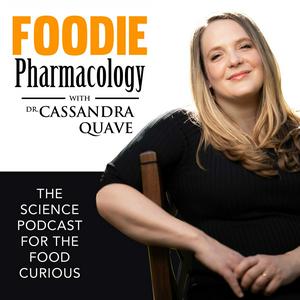
Foodie Pharmacology is the science podcast for the food curious! Dr. Quave is co-creator and host of the show. She speaks with leading experts on certain crops, sustainable farming methods, medicinal plants, and explores the pharmacology--or health impact--of our food through weekly episodes! You can also tune in through subscribing to the podcast on Apple Podcasts. Leave comments and ratings on episodes! Dr. Quave loves to hear from the #FoodiePharmacology fans!
Strona internetowa podcastuSłuchaj Foodie Pharmacology Podcast, Dr Tadeusz - O zdrowiu i zdrowym życiu i wielu innych podcastów z całego świata dzięki aplikacji radio.pl
Uzyskaj bezpłatną aplikację radio.pl
- Stacje i podcasty do zakładek
- Strumieniuj przez Wi-Fi lub Bluetooth
- Obsługuje Carplay & Android Auto
- Jeszcze więcej funkcjonalności
Uzyskaj bezpłatną aplikację radio.pl
- Stacje i podcasty do zakładek
- Strumieniuj przez Wi-Fi lub Bluetooth
- Obsługuje Carplay & Android Auto
- Jeszcze więcej funkcjonalności

Foodie Pharmacology Podcast
Zeskanuj kod,
pobierz aplikację,
zacznij słuchać.
pobierz aplikację,
zacznij słuchać.
 Polska

