PodcastyBiznesEdgy Ideas

Edgy Ideas

Simon Western
Edgy Ideas
Najnowszy odcinek

109 odcinków

  • Edgy Ideas

    108: Group Relations Conferences: Leadership, Authority and the Human Condition

    05.06.2026 | 42 min.
    Show Notes
    In this episode, Simon Western is joined by his long-time colleague, Leslie Brissett, to explore the history, purpose and enduring relevance of Group Relations Conferences. They trace the roots of this pioneering methodology from the early Leicester Conferences and the Tavistock Institute tradition to its contemporary applications in leadership, organisations and society. They discuss how Group Relations creates a temporary learning organisation where participants study authority, leadership, membership, and the unconscious in real time. They reflect on why these conferences can be deeply moving, often revealing hidden assumptions, internal constraints and patterns carried from our earliest relationships.
    Simon and Leslie also discuss the changing nature of leadership, the growing prominence of identity and systems thinking and the need to reconnect questions of soul, embodiment and spirituality with organisational life. Along the way, Simon shares how a Group Relations Conference helped him discover a different path to leadership - one that emerged not from hierarchy, but from working at the edge.
    This is a conversation about learning, freedom, authority and what it means to become more conscious participants in the systems we inhabit.
    Key Reflections

    Every Group Relations Conference is a unique, temporary learning organisation that can never be repeated in exactly the same way.

    Authority is not simply something exercised by leaders; it is shaped by how each of us relates to systems, roles, and early life experiences.

    Experiential learning can reveal aspects of ourselves that remain hidden in traditional education, coaching, therapy, or leadership development.

    Freedom often exposes the internal constraints and assumptions that unconsciously shape our behaviour.

    The origins of Group Relations are rooted in post-war efforts to understand authority, democracy, and the conditions that give rise to authoritarianism.

    Leadership does not only emerge from formal positions of power; it can arise from the edge of a system through connection and influence.

    Identity has become a more visible and important aspect of organizational life, inviting deeper reflection on both self and system.

    The future of Group Relations may lie in integrating embodiment, spirituality, and ecological ways of thinking with its psychoanalytic foundations.

    Keywords
    Group Relations, Leadership, Authority, Tavistock, Systems Thinking, Identity, Organisational Learning, Soul, Work
    Brief Bio
    Leslie has worked in organisational and community leadership for over 30 years. He is on the advisory board of the Eco-leadership Institute. He is the former Group Relations Programme Director at the Tavistock Institute of Human Relations, and is currently serving as the Board Secretary for the International Psychoanalytical Association. Leslie has studied human dynamics in experiential settings in many countries and acts as an adviser and consultant to boards, nations, groups and individuals seeking to improve the quality of life and deepen what it means to be human and humane. Leslie holds multiple degrees including master's degrees in Health Education from Kings College and Organisational Psychology, Social Policy and Non-Profit Policy from the London School of Economics and Political Science, as well as a PhD in Unconscious Decision Making from Trinity College.
  • Edgy Ideas

    107: The Emotional Life of Organisations with Anton Obholzer

    28.05.2026 | 29 min.
    Show Notes
    In this episode, Simon Western speaks with seasoned psychoanalyst and organisational consultant Dr. Anton Obholzer about the hidden emotional and relational dynamics shaping leadership, organisations and society. Anton is a hugely respected organisational consultant from the Tavistock tradition, and it is a delight to hear his wisdom and insights on this podcast. 
    Moving beyond technical models of management and mental health, the conversation explores organisations as living systems embedded within wider social and political realities. Anton reflects on the Tavistock tradition, the influence of Eric Miller and the importance of understanding organisations not simply as structures of efficiency, but as emotional containers carrying anxiety, projection, creativity and possibility. Simon and Anton discuss leadership as a protective and generative force, creating the conditions for growth, talent and human flourishing.
    The dialogue explores the erosion of relational life in contemporary society, the dangers of organisations becoming spaces for unmanaged social anxiety, and the increasing dominance of technological and managerial rationality over human connection. They examine the importance of experiential learning, vulnerability, observation and creative practice in sustaining healthy organisations and societies.
    At the heart of the episode is a deeper question about how we live together in increasingly uncertain times. Rather than retreating into expertise, certainty or control, Anton calls for greater relational awareness, collective responsibility and societal imagination.
    Key Reflections

    Organisations are emotional and societal systems, not simply technical machines

    Leadership involves creating protective spaces where people and creativity can flourish

    Psychoanalysis offers ways to understand the hidden dynamics shaping organisational life

    Relational intelligence matters more than purely technical expertise

    Organisations often absorb and enact wider societal anxieties and fractures

    Creativity, art and dialogue are essential to organisational and societal health

    Experiential learning creates deeper awareness than abstract theory alone

    Technological advancement risks intensifying alienation and loss of human contact

    Mental health cannot be separated from political, social and organisational conditions

    Healthy societies require interdependence, vulnerability and collective responsibility

    Keywords
    Psychoanalysis, Leadership, Organisational Dynamics, Tavistock, Anton Obholzer, Simon Western, Eco-Leadership, Relational Intelligence, Systems Thinking, Emotional Containment, Group Relations, Society, Human Connection, Organisational Culture, Creativity, Vulnerability, Interdependence.
    Brief Bio
    Dr. Anton Obholzer is a psychiatrist, Fellow of the Royal College of Psychiatrists, and both a child and adult psychoanalyst, trained at the Tavistock Clinic and the Institute of Psychoanalysis in London. Alongside his clinical work, he trained as an organisational consultant under Eric Miller at the Tavistock Institute of Human Relations, helping pioneer the application of psychoanalytic thinking to organisations, leadership, and institutional life.
    Until 2002, he served as Chief Executive of the Tavistock & Portman Clinics in London and continues as Chairman of the Consulting to Institutions Workshop and Senior Consultant in the Tavistock Consultancy Service. He has designed and directed group relations and management conferences internationally, and lectures widely on organisational change, leadership, and resistance under conditions of stress and turbulence.
    A Visiting Professor at the Universities of Vienna, Graz, and Innsbruck, faculty member at INSEAD’s Advanced Management Programme, and teacher across Europe, Dr. Obholzer has spent decades exploring the unconscious dynamics that shape organisations - especially when systems are under pressure.
    He is also the co-editor of the influential book The Unconscious at Work, a seminal text that examines how unconscious anxieties and emotional dynamics operate within organisations and institutions. His writings and publications have profoundly shaped the fields of systems psychodynamics, organisational consultancy, and leadership studies.
  • Edgy Ideas

    106: What happened to the working class?

    19.05.2026 | 35 min.
    Show Notes
    In this episode, Simon Western speaks with political theorist and author Professor Brad Evans about the collapse of traditional working-class politics and the growing sense of abandonment across post-industrial communities. Drawing on Brad’s experiences growing up in the South Wales Valleys, the conversation explores how solidarity, class identity and community structures have been eroded by deindustrialisation, neoliberalism and the rise of precarious labour. They reflect on why many working-class communities no longer feel represented by progressive politics and why populist movements are gaining traction.
    Simon and Brad discuss the emotional and political consequences of precarity - from Brexit and nationalism to homelessness, resentment and the rise of the “precariat.” Rather than dismissing people drawn toward nationalist or populist politics, they ask what happens when communities lose dignity, voice and recognition. The conversation challenges simplistic binaries of left and right, arguing instead for deeper listening, political humility, and a renewed understanding of interdependence.
    The episode also turns toward possibility. Simon introduces ideas from his work on “precarious interdependence,” asking how we might learn to live creatively within uncertainty rather than retreat into fear, certainty, and division. They discuss the role of art, culture, dialogue, and political imagination in creating more humane futures - futures grounded not in nostalgia for the past, but in new forms of solidarity and shared becoming.
    Key Reflections

    Working-class communities have not simply lost jobs, but also the social bonds and identities that once gave meaning and solidarity.

    Populist movements gain power when people feel politically abandoned, unseen and culturally dismissed.

    Precarity can produce fear and division, but it can also open possibilities for new forms of creativity, mutuality and transformation.

    Nationalism often emerges in spaces where class consciousness and collective identity have collapsed.

    Real political dialogue begins when we stop demonising opponents and start listening to the conditions shaping their lives.

    Art and culture are not luxuries; they are essential for reimagining society and creating empathetic futures.

    Keywords
    Precarity, Working Class, Nationalism, Populism, Brexit, South Wales, Political Violence, Class Identity, Labour Party,Identity Politics, Mutuality, Interdependence, Neoliberalism, Community, Deindustrialisation, Arts & Politics, Political Agency, Democracy, Social Change
    Brief Bio
    Brad Evans is a Professor of Political Violence & Aesthetics at the University of Bath, United Kingdom. He is the author of 20 books and edited volumes, along with over 150 academic and international media articles. Brad has written extensively on the state of international affairs, while making major theoretical contributions to the understanding of violence. He has previously held positions at the Universities of Bristol and Leeds, and has also taught at Columbia University in New York.
    Brad is widely known for bringing critical theory into public conversation through projects with The New York Times, Los Angeles Review of Books, and American Book Review. His recent work explores the politics of disappearance, bridging art, academia, and policy through exhibitions, public events, and global collaborations. He is also the founder of the internationally recognised Histories of Violence project, which connects critical research and public dialogue across more than 140 countries.
    A frequent speaker at institutions including Harvard, NYU, Columbia, UCLA, and the Guggenheim, Brad’s work moves between philosophy, politics, art, and lived experience. He is also the author of the acclaimed semi-biographical book How Black Was My Valley, reflecting on growing up in poverty in South Wales. His work and commentary have featured across major global media including the BBC, CNN, The New York Times, The Guardian, and Newsweek.
  • Edgy Ideas

    105: The Liberal Order and the Fight for the Soul

    23.03.2026 | 39 min.
    Show Notes
    In this episode of Edgy Ideas, Simon Western speaks with Gareth Owen OBE, former Humanitarian Director of Save the Children UK, about what it means to practice humanitarianism in a world where the global order is shifting rapidly. Drawing on more than three decades working in conflict zones - from Somalia and Angola to leadership roles shaping global humanitarian response - Gareth reflects on how humanitarian work has evolved. He describes how the aid sector grew alongside the post-Second World War liberal order, and how today that system is fragmenting under geopolitical tensions, rising authoritarianism and declining global cooperation.
    A key theme in the conversation is the growing bureaucratisation of humanitarian institutions. Gareth and Simon explore two key issues. Firstly the widening gap between frontline human suffering and the managerial systems that increasingly govern aid delivery.  Secondly the breakdown of the liberal international order and what it means for humanitarian work. The discussion turns to what Gareth calls the potential “loss of the humanitarian soul” - the relational depth, moral courage and human connection that once anchored the sector.  Rather than turn to nostalgia for the past, Gareth argues for a renewal grounded in solidarity, human-centred leadership, and new alliances that emerge beyond traditional institutions.
    Ultimately, the conversation asks a simple but demanding question: in an uncertain and fractured world, what are we each willing to stand up for?
    Key Reflections

    Humanitarianism is not a role or title; it is something learned through deep proximity to suffering.

    The humanitarian sector has become over-bureaucratised, often distancing itself from the people it claims to serve.

    The liberal rules-based order is breaking down, and with it the structures that once gave humanitarianism legitimacy and support.

    Aid institutions are caught between external political collapse and internal managerial systems that drain imagination and moral energy.

    The loss of reflective space inside organisations weakens their ethical compass and disconnects them from purpose.

    Humanitarian soul is rooted in relational depth, truth-telling, solidarity, and the willingness to remain open to pain.

    Real hope does not come from nostalgia for the old order, but from building new alliances, mutuality, and political courage.

    Change begins with self, but must move outward into communities, ecosystems, and collective action.

    Keywords
    Humanitarianism, liberal order, solidarity, aid sector, bureaucracy, managerialism, soul at work, ecosystems, leadership, mutuality, geopolitics, reflection, trauma, global crisis, moral courage

    Brief Bio
    Gareth Owen is the former Humanitarian Director of Save the Children UK (2007-2024). One of the sector’s most accomplished, influential and creative humanitarian practitioners; a passionate and inspirational leader of global renown; strategic thinker and critical reflector; outstanding communicator, systemic collaborator, team builder, talent developer, fundraiser and champion of change; chief architect of some of the humanitarian system’s most innovative and forward-looking collective initiatives. Over two decades, he crafted and led the growth of Save the Children UK’s humanitarian work and had a defining influence on the global Save the Children movement’s humanitarian renaissance. He built to worldwide pre-eminence a Humanitarian Department of 300 professionals then latterly initiated its consolidation and downsizing to catalyse shifting of power. In parallel, he co-founded and incubated the Humanitarian Leadership Academy, Elrha, the START Network, the Collaborative Cash Delivery Network and The Alameda Institute. A leading contemporary figure in the humanitarian sector, Gareth now offers his wealth of experience as a consultant, coach, author and lecturer.
  • Edgy Ideas

    104: When Anthropology meets Therapy

    20.02.2026 | 32 min.
    Show Notes
    What happens when anthropology turns its gaze on psychology and coaching?
    In this episode, Simon Western is joined by social anthropologist Dr Mikkel Kenni Bruun and social scientist Dr Rebecca Hutten to explore what sits beneath contemporary mental health, therapy, and coaching practices. Together, they discuss culture, power, and the often-invisible assumptions shaping therapeutic work.
    Rather than treating psychology as universal or value-neutral, Mikkel and Rebecca show how it is culturally produced, shaped by specific histories, institutions, and ways of making meaning. From this perspective, therapy and coaching are never neutral; they are embedded in social, political, and moral worlds.
    Ethnography is central to this conversation, not just as a research method, but as a way of listening and staying with complexity. Instead of forcing distress, healing, and care into predefined psychological categories, ethnography attends to how these experiences are actually lived across contexts.
    The discussion also challenges dominant Western ideas of the self. While psychology and coaching often centre the autonomous individual, anthropological perspectives highlight relational and socially embedded selves. This raises urgent questions about what happens when Western therapeutic models travel globally - and what they may erase or misunderstand.
    Cultural competence comes under scrutiny too. Often presented as a solution, it can risk flattening culture into tidy checklists rather than engaging with lived complexity and power. As psychological language increasingly shapes public policy, workplaces, and everyday life, anthropology helps reveal the cultural and political work happening beneath the surface.
    Key Takeaways

    Psychological and coaching practices are culturally produced, not universal

    Therapeutic cultures vary across histories, institutions, and contexts

    Ethnography reveals how mental health is actually lived

    The individual self is not a universal model

    Cultural competence can oversimplify difference

    Psychological practice is fundamentally relational

    Mental health discourse shapes ideas of the “good life”

    Anthropology makes the familiar strange - and visible again

    Keywords
    Anthropology, psychology, coaching, mental health, therapeutic culture, ethnography, cultural competence, relationality, self, good life
    Brief Bios
    Dr Mikkel Kenni Bruun is a social anthropologist at the University of Cambridge, Research Associate at the Healthcare Improvement Studies (THIS) Institute, and Affiliated Lecturer in the Department of History and Philosophy of Science. His ethnographic research includes NHS Talking Therapies (IAPT) services and community mental health initiatives in the UK. He is co-editor of Towards an Anthropology of Psychology (2025) and Rhythm and Vigilance (2025).
    Dr Rebecca Hutten is an independent researcher, social scientist, and Associate Lecturer at The Open University. Trained as an anthropologist, she has worked in government policy research and Public Health at the University of Sheffield, and brings extensive fieldwork and clinical experience within NHS psychological services. She is co-editor of Towards an Anthropology of Psychology (2025).
Więcej Biznes podcastów
O Edgy Ideas
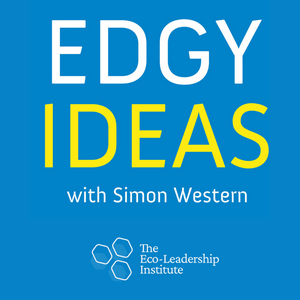
Welcome to Edgy Ideas, where we explore what it means to live a ‘good life’ and build the ‘good society’ in our disruptive age. This podcast explores our human dynamics in today's networked society. Addressing topical themes, we explore how social change, technology and environmental issues impact on how we live, and who we are - personally and collectively. Edgy Ideas podcast aims to re-insert the human spirit, good faith, ethics and beauty back into the picture, offering new perspectives and psycho-social insights. We pay particular attention to how the ‘unconscious that speaks through us’, entrapping us in repetitive patterns and shaping our desires. Each podcast concludes by contemplating what it means to live a ‘good life’ and create the ‘good society’. Enjoy! Edgy Ideas is sponsored by the Eco-Leadership Institute  A radical think tank and developmental hub for leaders, coaches and change agents. Join our community of practice and work live with many of our podcast guests Discover more here: https://ecoleadershipinstitute.org  Contact simon@ecoleadershipinstitute.org
Strona internetowa podcastu

Słuchaj Edgy Ideas, Excellent Work i wielu innych podcastów z całego świata dzięki aplikacji radio.pl

Uzyskaj bezpłatną aplikację radio.pl

  • Stacje i podcasty do zakładek
  • Strumieniuj przez Wi-Fi lub Bluetooth
  • Obsługuje Carplay & Android Auto
  • Jeszcze więcej funkcjonalności