Słuchaj tego podcastu za darmo w aplikacji: Pobierz za darmo z App Store
radio.pl
Sleep timer
Zapisz stacje
985 odcinków
Kevin Roose is AGI-pilled. Why aren't you?
26.10.2026 | 1 godz. 8 min.My guest today is Kevin Roose, a journalist and author of the new book The AGI Chronicles. Kevin was a longtime New York Times reporter and host of the popular podcast Hard Fork, but he and friend of the show Casey Newton just left The Times to start the all-new tech podcast Machine Gods, which launched last week.
Kevin and I talked about launching Machine Gods and what it’s like to go from mainstream media to being an independent creator. Of course, we also talked about his book, which is excellently reported dive into the companies racing to build machine intelligence.
Read the full interview transcript on The Verge.
Links:
The AGI Chronicles | Kevin Roose
Can AI replicate in your smart TV? | Machine Gods (YouTube)
Introducing Machine Gods | Platformer
Inside the biggest feud in artificial intelligence | The Atlantic
The essay that started the AI race | Kevin Roose
A conversation with Bing’s chatbot left me deeply unsettled | NYT
Subscribe to The Verge to access the ad-free version of Decoder!
Credits:
Decoder is a production of The Verge and part of the Vox Media Podcast Network.
Decoder’s producers are Greg Ott, Kate Cox, and Nick Statt. This episode was edited by Kabir Chopra. Our editorial director is Kevin McShane.
The Decoder music is by Breakmaster Cylinder.
Learn more about your ad choices. Visit podcastchoices.com/adchoicesBill Gates says to prepare for 20 years of ‘tumultuous’ AI disruption
22.10.2026 | 1 godz. 16 min.My guest today is Bill Gates, co-founder and former CEO of Microsoft and chairman of the Gates Foundation. You may have noticed Bill in the news more lately — he’s been on something of a tour for the past few months talking about AI risk, and how crucial it is that we start taking this seriously.
So I was excited to sit down with him and really dig into this subject. I came with many questions, about AI policy, the technical aspects of alignment, and what it means for future generations that we’re building something this disruptive and potentially dangerous.
Read the full interview transcript on The Verge.
Links:
The turbulent AI era is here. The choices we make now are critical. | Bill Gates
"OG" Bill Gates returns to wage war on AI risks | Axios
Bill Gates’s blunt warning on AI | The Ezra Klein Show
Ben Horowitz criticizes Bill Gates, Anthropic over AI safety | All-In Pod
Does Anthropic think Claude is alive? Define ‘alive’ | The Verge
Microsoft AI CEO says Anthropic is making AI risks worse | Decoder
Bill Gates has a good feeling about AI | The Verge (2024)
The risks of AI are real but manageable | Bill Gates (2023)
Subscribe to The Verge to access the ad-free version of Decoder!
Credits:
Decoder is a production of The Verge and part of the Vox Media Podcast Network.
Decoder’s producers are Greg Ott, Kate Cox, and Nick Statt. This episode was edited by Ursa Wright. Our editorial director is Kevin McShane.
The Decoder music is by Breakmaster Cylinder.
Learn more about your ad choices. Visit podcastchoices.com/adchoicesJB Pritzker thinks AI could help us live to 100 — or threaten us like nukes
19.10.2026 | 59 min.Illinois Gov. JB Pritzker, has a lot of thoughts about AI, tech, and privacy. Those issues are driving a big and maybe kind of unexpected political realignment — and with the midterms coming up next month, and early voting already underway in a lot of places, the stakes are pretty high right now. And as he notes, some problems are just collective action problems that require a government. We can’t solve everything one at a time, or even one state at a time.
And of course, I had to ask him: Are the Bears gonna stay in Illinois?
Links:
How ordinary Utahns fought the biggest data center in the world | The Verge
New York Gov. Kathy Hochul thinks AI should be ‘less evil’ | Decoder
YouTube CEO: ‘We’re focused on internal safety efforts’ | CNN
Pritzker signs landmark AI regulation bill | Capitol News Illinois
Pritzker establishes AI Cabinet amid calls for regulation | NPR Ilinois
Subscribe to The Verge to access the ad-free version of Decoder!
Credits:
Decoder is a production of The Verge and part of the Vox Media Podcast Network.
Decoder’s producers are Greg Ott, Kate Cox, and Nick Statt. This episode was edited by [TK EDITOR]. Our editorial director is Kevin McShane.
The Decoder music is by Breakmaster Cylinder.
Learn more about your ad choices. Visit podcastchoices.com/adchoicesWhy Elon Musk wants to sell you cell service
17.10.2026 | 53 min.My guest today is Walter Piecyk, a telecom analyst at LightShed Partners, and we’re discussing SpaceX’s plan to become a major wireless carrier. Last week, the company agreed to buy a big chunk of low-band spectrum in its bid to build “the world’s most advanced mobile network.”
So I wanted to dig into whether SpaceX can pull this off, why Walt thinks the existing telecoms have fumbled their response to Starlink’s growing threat, and what happens when Elon Musk’s rocket company jumps headfirst into a business everyone loves to hate.
Read the full interview transcript on The Verge.
Links:
SpaceX announces plan to become a ‘major mobile carrier’ | The Verge
SpaceX has a plan. Do the telcos? | LightShed Partners
EchoStar offloads satellite spectrum to SpaceX for $17 billion | The Verge
FCC Grants SpaceX Approval for 15,000 Direct-to-Device Satellites | Via Satellite
AT&T CEO says Elon Musk's SpaceX phone strategy not "viable" | Axios
SpaceX Sends Telecom Providers a Shot Across the Bow | WSJ
Verizon: No to an MVNO with Starlink | Fierce Network
Subscribe to The Verge to access the ad-free version of Decoder!
Credits:
Decoder is a production of The Verge and part of the Vox Media Podcast Network.
Decoder’s producers are Greg Ott, Kate Cox, and Nick Statt. This episode was edited by Eileen Felix. Our editorial director is Kevin McShane.
The Decoder music is by Breakmaster Cylinder.
Learn more about your ad choices. Visit podcastchoices.com/adchoicesBenn Jordan thinks the surveillance problem is much bigger than Flock
15.10.2026 | 1 godz. 2 min.Today, I’m talking with Benn Jordan, musician, YouTuber, researcher, and investigative journalist. In the last couple of years, Benn has become a high-profile face in the creator and media spaces for his work investigating Flock Safety, the maker of automatic license plate readers and the software that powers them.
Benn recently testified in front of Congress at a hearing dedicated to Flock and other ALPR systems. So of course I wanted to dig into all of that with Benn, not just because of his role as a Flock critic, but because he’s also become in some ways the face of a new front in the broader debate about surveillance and privacy.
Read the full interview transcript on The Verge.
Links:
Benn Jordan testifies in front of Senate | Benn Jordan (YouTube)
Flock values their privacy. Oh well | Benn Jordan (YouTube)
We Hacked Flock Safety Cameras in under 30 Seconds | Benn Jordan (YouTube)
Lawmakers introduce multiple laws to curb Flock | 404 Media
The fight over Flock and other ALPRs | The Verge
Sanders, AOC, Merkley propose bill to ban Flock cameras | Politico
Cities terminate Flock contracts at record pace in August | Ars Technica
Flock to cut several hundred jobs amid backlash | Reuters
Subscribe to The Verge to access the ad-free version of Decoder!
Credits:
Decoder is a production of The Verge and part of the Vox Media Podcast Network.
Decoder’s producers are Greg Ott, Kate Cox, and Nick Statt. This episode was edited by Ursa Wright. Our editorial director is Kevin McShane.
The Decoder music is by Breakmaster Cylinder.
Learn more about your ad choices. Visit podcastchoices.com/adchoices
Więcej Biznes podcastów





Trendy w podcaście Biznes






O Decoder with Nilay Patel
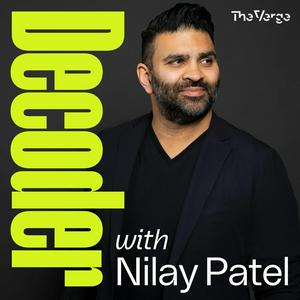
Decoder is a show from The Verge about big ideas — and other problems. Verge editor-in-chief Nilay Patel talks to a diverse cast of innovators and policymakers at the frontiers of business and technology to reveal how they’re navigating an ever-changing landscape, what keeps them up at night, and what it all means for our shared future.
Strona internetowa podcastuSłuchaj Decoder with Nilay Patel, PB Podcasty i wielu innych podcastów z całego świata dzięki aplikacji radio.pl
Uzyskaj bezpłatną aplikację radio.pl
- Stacje i podcasty do zakładek
- Strumieniuj przez Wi-Fi lub Bluetooth
- Obsługuje Carplay & Android Auto
- Jeszcze więcej funkcjonalności
Uzyskaj bezpłatną aplikację radio.pl
- Stacje i podcasty do zakładek
- Strumieniuj przez Wi-Fi lub Bluetooth
- Obsługuje Carplay & Android Auto
- Jeszcze więcej funkcjonalności
Decoder with Nilay Patel
Zeskanuj kod,
pobierz aplikację,
zacznij słuchać.
pobierz aplikację,
zacznij słuchać.
Decoder with Nilay Patel: Podcasty w grupie

 Polska