

Słuchaj tego podcastu za darmo w aplikacji: Pobierz za darmo z App Store
radio.pl
Sleep timer
Zapisz stacje
184 odcinków

# 183 The 3 Levels of AI Automation (full playbook)
23.07.2026 | 1 godz.In this episode, I sit down with Greg and give away the entire playbook behind our AI Tools Assessment offer, the simplest AI-powered business model you can start in 2026 with zero AI skills, zero audience, and zero capital. I walk through the exact four-phase process we use to run a $999 assessment for small business owners, the client-facing report template (which you can download for free), and the six-item upsell menu that turns a $999 foot-in-the-door offer into $3K, $5K, and $10K+ engagements. I also break down my current AI Concierge retainer, which is generating me over $1,000 an hour, and the seven no-capital, no-audience client acquisition methods I'm using right now to fill my pipeline. By the end of this episode, you'll have the full stack: the offer, the fulfillment process, the upsells, and how to actually go get clients.
Grab the free AI Tools Assessment report template (built in Claude Design, plug-and-play for your own clients): https://audittemplate.ai
Join our AI Operator Academy Community where we help entrepreneurs start and scale a profitable AI services business: https://www.skool.com/aioperatoracademy/about
Timestamps
00:00 - Intro: The Simplest AI Business Model of 2026
02:00 - Why Give Away the Entire Playbook (Blue Ocean Opportunity)
03:30 - The AI Tools Assessment Offer Explained ($999, 45 Mins)
05:00 - The 5-Hour Guarantee & Average Client Results
09:00 - Phase 1: The Discovery Call & The Magic Wand Question
13:00 - Phase 2: Feeding the Transcript to Claude for Tool Research
15:00 - Quality Assurance & Making Judgment Calls
18:00 - Best Tool Directories: Futurepedia & There's An AI For That
19:30 - Phase 3: Building the Client Report in Claude Design
24:00 - Free Download: The AuditTemplate.ai Report Template
27:30 - The Effort vs. Impact Matrix & Quick Wins
32:00 - Why Most Recommendations Are Simple SaaS Tools (Not Big AI)
34:00 - Phase 4: The Review Call & The 3 Closing Questions
37:30 - Upsell 1: Process Redesign (Fixing Broken Workflows First)
39:00 - Upsell 2: Simple Zapier, Make & n8n Automations
41:00 - Upsell 3: Knowledge Systems (The Business Broker Example)
43:30 - Upsell 4: Custom Claude Skill Workflows & Retainers
46:00 - Upsell 5: Full Implementation Packages
47:30 - 7 Ways to Find Clients With No Capital or Audience
59:30 - The AI Concierge Offer: $1,000+/hr Done-With-You Consulting
1:05:00 - The AOA Framework: Audit, Optimize, Automate
1:07:00 - Why Niching Down Is the Key to Pricing Power
1:09:00 - Wrap-Up
Key Points
The AI Tools Assessment is a $999, 45-minute structured interview where you prescribe three to seven off-the-shelf AI tools that reclaim at least five hours a week for the client, backed by a 100% money-back guarantee if you can't find that time.
The fulfillment process is four phases: a recorded discovery call to surface pain points, feeding that transcript to Claude to research matching tools, building a templated client report in Claude Design, and a review call that ends with three closing questions to surface the upsell.
A confused mind doesn't buy, doesn't implement, and doesn't upsell. The report is built around an effort versus impact matrix that isolates "quick wins," a four-day quick start plan, and a financial impact slide that shows exact monthly ROI.
There are six upsells after the assessment: process redesign, simple automation builds, knowledge systems, custom Claude skill workflows, retainers, and full implementation packages, with average tool costs around $60 a month against thousands of dollars in monthly ROI.
Seven ways to find clients without capital or an audience: hosting a local AI meetup, door knocking, LinkedIn DMs that lead with pain instead of pitching, free mini-audits for your network, agency referral partnerships, AI office hours at co-working spaces, and posting your wins publicly.
The AI Concierge offer is two 45-minute monthly calls plus Voxer access, teaching clients to use Claude Cowork and build their own Claude skills. It closed five of the first six people pitched and hit 8K MRR in ten days.
Crediting the $999 assessment fee toward a bigger upsell, while quietly marking the upsell up to stay profitable, is one of the most effective ways to get a prospect off the fence.
Links mentioned:
Futurepedia.io, a large AI tool directory recently acquired by HubSpot - https://www.futurepedia.io
TheresAnAIForThat.com, an AI tool directory searchable by industry - https://theresanaiforthat.com
Gamma, the tool used early on to build assessment reports - https://gamma.app
Claude, used to research tools from the discovery call transcript and to build client-facing skills - https://claude.ai
Audittemplate.ai, free download of the exact AI Tools Assessment report template used in Claude Design - https://audittemplate.ai
Fathom, the AI note taker used to record and transcribe discovery calls - https://fathom.video
Sanebox, the most-prescribed tool for getting clients out of email overload - https://www.sanebox.com
Zapier, used for simple one-to-three-step automation builds - https://zapier.com
Make, used for automation builds as an alternative to Zapier - https://www.make.com
n8n, another automation platform used for client workflow builds - https://n8n.io
FIND ME ON SOCIAL
X/Twitter: https://x.com/coreyganim
Instagram: https://www.instagram.com/coreyganim/
LinkedIn: https://www.linkedin.com/in/coreyganim/
YouTube: https://www.youtube.com/@coreyganim# 182 The Ultimate AI Services Free Course ($0-$10K in 30 Days)
20.07.2026 | 1 godz. 7 min.Download the full AI Services Resource Library including every resource mentioned in this episode (free): Steal the Entire AI Services Resource Pack
This is the full AI services business course, A to Z, completely free. I walk through exactly how I built a business that hit $8,000 in MRR in 10 days and now generates over $1,000 an hour, starting with one lunch conversation with a commercial real estate broker who offered to pay me to find AI opportunities in his business. I break down the entire three-offer ladder: the free mini assessment that gets you in the door, the $999 paid AI tools assessment, and the AI Concierge retainer that's now the majority of my personal income. You'll see the exact scripts, the Claude skills, the Notion and JotForm templates, and the pricing psychology behind all of it. By the end of this episode, you'll have a full playbook to go from zero to your first $5,000-$10,000 in revenue in 30 days.
Join our AI Operator Academy Community where we help entrepreneurs start and scale a profitable AI services business: https://www.skool.com/aioperatoracademy/about
Timestamps
00:00 – Intro and the AI Concierge origin story
02:24 – The AOA framework: Audit, optimize, automate
04:43 – The three-offer ladder overview
07:06 – How the free mini assessment works
09:31 – The magic wand question
14:20 – Prescribing the right tool and teeing up the upsell
19:04 – Building a voice agent to run assessment interviews
21:26 – Using a Claude skill to score pain points and tools
23:47 – Inside the six-part assessment report
31:01 – Why $1,000 is the minimum assessment price
33:25 – Defining the AI Concierge retainer offer
40:30 – Automating the concierge backend with Claude skills
52:25 – Four ways to find your first clients
01:04:08 – The 30-day plan to your first $5K–$10K
Key Points
Every AI implementation has to pull one of three ROI levers: effectiveness, meaning it makes you more money, efficiency, meaning it saves you time, or quality, meaning it improves your product, service, or customer experience. If it doesn't hit one of those, it's not worth doing.
The AOA framework governs everything: audit the process as it's done manually today, optimize by cutting the fat, and only then automate. Business owners who skip straight to automate usually fail because they never simplified the process first.
The free 15-minute mini assessment is the tripwire offer. Ask about repetitive tasks, friction points, and hourly value, then close with the magic wand question. Done right, this converts 30-50% of people into the $999 paid assessment.
Never charge less than $1,000 for the paid AI tools assessment. Pricing it at $200 and then $500 still got yeses, but clients didn't take the recommendations seriously until the price hit $1,000 and they had real financial skin in the game.
The AI Concierge retainer runs $1,000-$2,000 a month for two 45-minute working sessions, and Corey's blended hourly rate across his five current clients comes out to roughly $1,250 an hour.
Four Claude skills automate the entire concierge backend, intake to project files, call update, follow-up email, and an orchestrator called AI Concierge Post Call that chains the last two together, cutting admin work down to under five minutes per client per week.
Both the assessment and the concierge offer run at about 99.8% net margin since the only real cost is a $20-a-month Claude subscription.
Links Mentioned: AI Tools Assessment Report Template: https://audittemplate.ai SaneBox: https://sanebox.com Futurepedia: https://futurepedia.io There's An AI For That: https://theresanaiforthat.com
FIND ME ON SOCIAL
X/Twitter: https://x.com/coreyganim
Instagram: https://www.instagram.com/coreyganim/
LinkedIn: https://www.linkedin.com/in/coreyganim/
YouTube: https://www.youtube.com/@coreyganim# 181 Best AI startup idea of 2026 (I'm making $1,000/hour with it)
16.07.2026 | 25 min.Grab the Free report template: https://audittemplate.ai
Grab the full Excalidraw diagram: AI Assessment framework (public) — Excalidraw Plus
This is the full AI assessment masterclass. I walk through the four phases of the $999 AI tools assessment, the expansion menu of services you can sell after, seven ways to find clients without spending any money, and then the AI concierge upsell that is generating over a thousand dollars an hour for me right now. I have five clients on the concierge offer paying between twelve hundred and two thousand dollars a month each for two 45-minute calls. That is the entire deliverable. This episode gives you the full playbook end to end so you can go do this yourself.
Join our AI Operator Academy Community where we help entrepreneurs start and scale a profitable AI services business: https://www.skool.com/aioperatoracademy/about
Timestamps
00:00 – Intro: The full AI assessment masterclass
00:30 – What is the AI tools assessment and how does it work?
01:30 – Phase 1: The 45-minute discovery call and key questions to ask
02:24 – Phase 2: AI analysis, Claude finds 3-7 tools from the transcript
03:30 – Using Futurepedia and There's an AI for That to fill gaps
04:00 – Phase 3: The report, nine slides in Claude Design
04:54 – Effort versus impact matrix, quick wins, financial impact
05:30 – Phase 4: The review call, walking through the report
06:00 – Three closing questions that convert 50-60% into paid work
06:30 – The expansion menu: what to sell after the assessment
07:00 – Process redesign at $3,000–$3,500
07:30 – Automation builds at $1,000–$7,000
08:00 – Knowledge systems at $3,000 with the business broker example
09:40 – Custom workflows: prompt packs, skill packs, templates at $3,000–$5,000
10:00 – Full implementation at $5,000–$10,000+
10:30 – Seven ways to sell with no money and no audience
11:00 – Method 1: Host a local AI meetup
12:07 – Method 2: Door knock 30 businesses, the DM success story
13:00 – Method 3: LinkedIn DMs targeting CEOs with 10-50 employees
13:30 – Method 4: Free audits to your existing network
14:20 – Method 5: Agency partners, become the AI guy for your CPA
15:30 – Method 6: Free AI office hours at a co-working space
16:44 – Method 7: Post your wins on LinkedIn
18:00 – The AI concierge offer: done-with-you consulting at $1,200–$2,000/month
19:10 – The math: $750–$1,250 per hour effective rate
20:00 – Call 1: Onboarding to Claude Cowork with the plugin
21:00 – Every call after: AOA on their workflows one at a time
21:32 – What makes it feel premium: onboarding form, Notion hub, Voxer
23:56 – Why this is the best AI startup idea of 2026
Key Points
The AI tools assessment is the front door. For $999, you sit down with a business owner for 45 minutes, pull out their pain points, have Claude find three to seven off-the-shelf tools, and deliver a nine-slide report. Fifty to sixty percent of the time, they want paid help implementing what you prescribed.
The four phases are discovery call, AI analysis, report delivery, and review call. Phase two is where Claude does the heavy lifting by analyzing the transcript and finding tools. Phase four is where you close by asking which recommendation is most urgent, whether they want help, and what their timeline is.
The expansion menu has five tiers: process redesign at three to three and a half thousand, automation builds at one to seven thousand, knowledge systems at three thousand, custom workflows at three to five thousand, and full implementations at five to ten thousand or more.
Seven ways to sell with no money and no audience: host a local AI meetup, door knock local businesses, LinkedIn DMs targeting CEOs, free audits to your existing network, agency and referral partners, free AI office hours at a co-working space, and post your wins consistently on LinkedIn.
The AI concierge is the highest dollar-per-hour offer. Two 45-minute calls per month at twelve hundred to two thousand dollars a month puts your effective hourly rate between $750 and $1,250. With five clients, total admin outside the calls is almost zero thanks to Claude skills that handle follow-up emails and Notion updates.
The Notion hub is the renewal engine. After every call, a Claude skill logs the top three takeaways, action items, and an inventory of everything built. When the client looks at that ledger, they see undeniable value and keep renewing.
Voxer is the high perceived value bonus that almost nobody uses. Five clients over three months generated a total of four Voxer messages. The 12-hour SLA makes it feel premium without adding real workload.
Links Mentioned:
Futurepedia: https://www.futurepedia.io
There's an AI for That: https://theresanaiforthat.com
Fathom: https://fathom.video Voxer: https://www.voxer.com
If this episode was valuable to you, it would mean a lot if you left a rating and review on Apple Podcasts or Spotify. It helps more entrepreneurs find the show.
FIND ME ON SOCIAL
X/Twitter: https://x.com/coreyganim
Instagram: https://www.instagram.com/coreyganim/
LinkedIn: https://www.linkedin.com/in/coreyganim/
YouTube: https://www.youtube.com/@coreyganim# 180 The single best way to get leads for your AI services business (full guide)
13.07.2026 | 21 min.Grab the AI for Business Meet up Prompt (free) www. Steal the AI for Business Meetup Prompt.com
This is the full playbook for hosting a local in-person AI for business meetup that generates leads and clients for your AI services business. I modeled this on my friend Andrew Hewitt's Triad Dev Connect event, which has generated eighty thousand dollars in attributed revenue over seven months at a cost of about four thousand dollars per year. I adapted his model for non-technical business owners and had Claude generate a single prompt that produces every deliverable from venue research to follow-up sequences to a full operating SOP. I walk through the entire prompt and every phase of the plan in this episode. The prompt is free in the description if you want to grab it and run it yourself.
Join our AI Operator Academy Community where we help entrepreneurs start and scale a profitable AI services business: https://www.skool.com/aioperatoracademy/about
Timestamps
00:00 – Intro: How to use the AI prompt
01:00 – The Quarterly Rock: 3 events & closing a client by September
02:21 – The Strategy: Why this event exists (Leads, authority, & content)
03:30 – Target Audience (ICP): Reaching non-technical business owners
04:47 – Case Study: How Andrew made $80K from a monthly meetup in 7 months
07:30 – Phase 1: Venue research & the perfect pitch email
09:31 – Phase 2: Designing a high-impact 90-minute event format
10:30 – The Soft CTA: Pitching the free 15-minute AI assessment
12:30 – Phase 3: Marketing through local Facebook groups
14:17 – The Co-Host Strategy: Partnering with Facebook group owners
16:00 – Phase 4: Setting up Luma for lead capture & attribution
16:35 – Phase 5: Email follow-up sequences based on lead temperature
18:30 – Phase 6: Team execution & Standard Operating Procedures (SOPs)
19:01 – Phase 7: The Playbook Call with an active organizer
19:30 – Phase 8: Building a Scoreboard for weekly & monthly metrics
21:27 – Outro: Download the prompt for free!
Key Points
The entire event playbook is generated from a single Claude prompt. You give Claude the context about who you are, what you sell, and what your quarterly goal is, and it produces every deliverable: venue research, event format, marketing plan, follow-up sequences, attribution system, operating SOP, and a scoreboard.
The model is proven. Andrew Hewitt's Triad Dev Connect in Winston-Salem has generated eighty thousand dollars in directly attributed revenue over seven months at a cost of about four thousand dollars per year. That works out to roughly eleven thousand dollars a month from one monthly event.
The ICP is non-technical business owners. Every talk, demo, post, and email must pass the non-technical test. If a slide has code on it, that speaker does not speak. There is already a large developer-focused meetup in Charlotte, which means there is a massive gap for this audience.
The marketing engine relies on local Facebook groups. Claude found nine Charlotte business groups with tens of thousands of members. The strategy is to join the groups, introduce yourself, then promote the event with three distinct post variations. The highest leverage move is getting one Facebook group owner to co-host and drive traffic.
Attribution is built into the Luma registration. Three simple questions capture what the attendee does, what they want AI to fix, and how they heard about you. That data triages everyone into hot leads for services, warm leads for the community, nurture contacts for the newsletter, and no-shows who get a recap email and next month's date.
The rock measurables keep it accountable: three events held this quarter, at least 25 attendees by the third event, full attribution tracking from event one, and at least one closed AI concierge or services client by September 30th.
The operating SOP means you only do the heavy lift once. Claude produces a checklist from five weeks out to two days out covering everything from venue confirmation to post-event data entry. After event one, the team runs event two and three with zero input from you.
Links Mentioned
Luma: https://lu.ma
If this episode was valuable to you, it would mean a lot if you left a rating and review on Apple Podcasts or Spotify. It helps more entrepreneurs find the show.
FIND ME ON SOCIAL:
X/Twitter: https://x.com/coreyganim
Instagram: https://www.instagram.com/coreyganim/
LinkedIn: https://www.linkedin.com/in/coreyganim/ YouTube: https://www.youtube.com/@coreyganim# 179 The AI Operating System that sells itself (zero delivery work)
09.07.2026 | 33 min.Justin Brooke from Agent Skills is back on the podcast, and this time he walks us through the full business model behind selling AI systems as zip files with zero delivery work. His system is called CMO HQ, a marketing and sales operating system built entirely out of folders and markdown files that works with any AI, whether it is Claude, ChatGPT, Hermes, Codex, or anything else. The delivery model is dead simple: the customer buys from a sales page, receives a zip file with an operations manual and an installer dot MD file, hands that file to their AI of choice, and the AI builds out the entire system for them. No onboarding calls, no Loom walkthroughs, no custom setup. Justin shows us the full folder structure, the finance layer, a live content pipeline, and the actual installer file on screen.
Join our AI Operator Academy Community where we help entrepreneurs start and scale a profitable AI services business: https://www.skool.com/aioperatoracademy/about
Timestamps
00:00 - Intro: Justin Brooke is back
00:23 - What CMO HQ is and why it works with any AI
01:23 - The folder structure: HQ, brands, finance, shared
03:30 - Brands folder: one per brand with intelligence, departments, and metrics
04:10 - The finance folder and why it matters for true marketing metrics
05:14 - The installer.md file that builds the whole system
05:45 - Why this is the simplest marketing OS out there
05:50 - Inside the finance folder: revenue, expenses, economics, reporting
06:48 - Connecting Google Ads, Kit, Thrivecart, and Xeny for full-picture data
07:56 - Building in iCloud for access from any device
09:27 - Marketing departments: paid, earned, and owned channels
10:00 - The sacred pipeline: active to review to publish
11:06 - Live example: faith-based niche site blog post end to end
13:30 - Automated performance reporting via MCP connections
15:18 - Why Justin does everything in Claude Cowork, not Claude Code
15:45 - How to sell any AI-generated asset to clients
16:25 - The delivery problem and why folders and files solve it
17:24 - The two-file delivery: operations manual plus installer.md
19:13 - Session transfer documents and how the system started
20:19 - Changelog.md for tracking business decisions
20:46 - The jobs to be done framework for building any system
22:01 - Jobs equal folders, instructions equal markdown files, which equal skills
23:26 - Why the nerds who want to build it themselves are not your customers
24:33 - Step one: jobs to be done, then vibe with Claude to build folders
26:00 - Three things every agent needs: memory, instructions, tools
26:18 - Why you should use a slide deck on every sales call
28:25 - The installer file walkthrough on screen
30:27 - Why this means zero delivery work
31:14 - Where to find Justin and Build Club
32:22 - Justin hangs out mostly on Twitter
Key Points
The entire system is folders and markdown files. No code, no complex frameworks, no platform lock-in. It works with Claude, ChatGPT, Hermes, Codex, or any other AI because all of them can read folders and files.
The delivery model eliminates all fulfillment work. Customers buy from a sales page, receive a zip file containing an operations manual and an installer dot MD file, hand that installer to their AI, and the AI builds out the entire system. No calls, no custom setup, no support tickets.
The installer dot MD file is the key innovation. It contains a greeting, an interview section that asks the customer about their business, and then the full folder structure with instructions. The AI reads it and builds everything automatically in one session.
CMO HQ has four main sections: an HQ folder for personal and business identity, a brands folder with one subfolder per brand containing intelligence, departments, and metrics, a finance folder that connects to accounting and ad platforms for real financial reporting, and a shared folder for team collaboration.
The jobs to be done framework is how you replicate this for any niche. Figure out what jobs need to be done in a business, make a folder for each job, put instructions in each folder, and you have a sellable system. Dentists, lawyers, agencies, any vertical works the same way.
Three things every agent needs: memory so it knows what happened, instructions so it knows what to do, and tools so it can do the work. If you have those three things in folders and files, you can handle any job.
The sales advice is simple and powerful: stop doing calls on the fly and use a slide deck for every sales call. It keeps you on pace, makes every call uniformly good by the fifth or sixth time, and becomes the training material when you hire a salesperson.
Links Mentioned
Agent Skills / Build Club: https://agentskills.ai Jake Van Cleef (ICM system and folders-and-files research): mentioned, search YouTube Ghost CMS: https://ghost.org 11 Labs: https://elevenlabs.io
If this episode was valuable to you, it would mean a lot if you left a rating and review on Apple Podcasts or Spotify. It helps more entrepreneurs find the show.
FIND ME ON SOCIAL
X/Twitter: https://x.com/coreyganim
Instagram: https://www.instagram.com/coreyganim/
LinkedIn: https://www.linkedin.com/in/coreyganim/
YouTube: https://www.youtube.com/@coreyganim
FIND JUSTIN ON SOCIAL
X/Twitter: https://x.com/agentskills_ai
https://x.com/IMJustinBrooke
Agent Skills: https://agentskills.ai
Więcej Biznes podcastów
 Inwestomat - oszczędzanie, inwestowanie, wolność finansowaBiznes, Inwestowanie
 PB BRIEFBiznes
 EkonomicznieBiznes
 PB PodcastyBiznes
 Maciej Wieczorek - Expert w BentleyuBiznes
 Nowoczesna Sprzedaż i MarketingBiznes, Marketing, Przedsiębiorczość
 The Diary Of A CEO with Steven BartlettBiznes, Edukacja, Społeczeństwo i Kultura
 ZSŻBiznes
 Moja drogaBiznes, Kariera, Przedsiębiorczość, Zarządzanie
Trendy w podcaście Biznes
 Excess ReturnsBiznes, Inwestowanie
 Piotr Zając o rynkachBiznes, Inwestowanie
 TECHNOFOBIABiznes, Przedsiębiorczość
 Lider(ka) na DywanikuBiznes, Edukacja, Kariera, Samodoskonalenie, Zarządzanie
 Mon argentBiznes, Edukacja, Nauka Języków
 Invest Like the Best with Patrick O'ShaughnessyBiznes, Inwestowanie, Technologia
 The Game with Alex HormoziBiznes, Edukacja, Instrukcje, Przedsiębiorczość
 CTO Morning CoffeeBiznes, Kariera, Technologia
 Aspire with Emma GredeBiznes, Przedsiębiorczość, Społeczeństwo i Kultura
 Financial AuditBiznes, Edukacja, Inwestowanie, Samodoskonalenie
 Worklife with Molly GrahamBiznes, Kariera, Przedsiębiorczość, Zarządzanie
 Greg Albrecht Podcast: Biznes, Strategia i PrzywództwoBiznes
 The Ramsey ShowBiznes, Edukacja, Inwestowanie, Samodoskonalenie
 Sprzedaż i biznes- zwiększmy Twoją sprzedaż 🔥Biznes, Edukacja, Kursy, Przedsiębiorczość
 A Bit of OptimismBiznes, Edukacja, Kariera, Samodoskonalenie
 Jocko PodcastBiznes, Historia, Zarządzanie
- Moja drogaBiznes, Kariera, Przedsiębiorczość, Zarządzanie
- Nowoczesna Sprzedaż i MarketingBiznes, Marketing, Przedsiębiorczość
 Girls Money Club PodcastBiznes, Edukacja, Inwestowanie
 FoundersBiznes, Historia, Przedsiębiorczość, Technologia
 Build with Leila HormoziBiznes, Edukacja, Instrukcje, Przedsiębiorczość, Zarządzanie
 Business WarsBiznes, Historia, Zarządzanie
 Kuba Łyko PodcastBiznes, Przedsiębiorczość
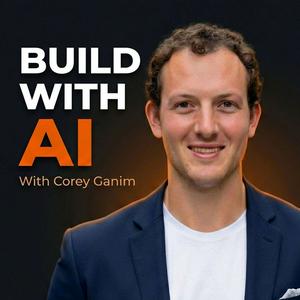
O Build With AI
Most AI podcasts talk about what's possible. Build With AI shows you how it's done, live. Each episode, host Corey Ganim brings on entrepreneurs and operators who share their screen and build real AI automations, workflows, and tool setups right in front of you. No boring slides. Nothing that hasn't been battle-tested. You'll watch actual implementations get built from scratch so you can follow along and do the same in your business. If you're a non-technical entrepreneur who wants to put AI to work without becoming a developer, hit play and build along with us.
Strona internetowa podcastuSłuchaj Build With AI, The Diary Of A CEO i wielu innych podcastów z całego świata dzięki aplikacji radio.pl
Uzyskaj bezpłatną aplikację radio.pl
- Stacje i podcasty do zakładek
- Strumieniuj przez Wi-Fi lub Bluetooth
- Obsługuje Carplay & Android Auto
- Jeszcze więcej funkcjonalności
Uzyskaj bezpłatną aplikację radio.pl
- Stacje i podcasty do zakładek
- Strumieniuj przez Wi-Fi lub Bluetooth
- Obsługuje Carplay & Android Auto
- Jeszcze więcej funkcjonalności
Build With AI
Zeskanuj kod,
pobierz aplikację,
zacznij słuchać.
pobierz aplikację,
zacznij słuchać.
 Polska