PodcastyBiznesThe AI Cookbook Show by Malcolm Werchota

The AI Cookbook Show by Malcolm Werchota

Malcolm Werchota
The AI Cookbook Show by Malcolm Werchota
Najnowszy odcinek

198 odcinków

  • The AI Cookbook Show by Malcolm Werchota

    #125 - [Quickbite] - Microsoft Bans Claude Code — and Takes the Ferrari Away From Its Engineers

    01.06.2026 | 17 min.
    Imagine your company car is a Lamborghini. Or a Ferrari — doesn't matter. You drive it to work every day. You're productive. You're happy. And then your CEO walks in and says: "Starting next month, you're driving a Skoda Octavia."
    That's exactly what just happened at Microsoft. And it affects you directly — even if you've never written a line of code.
    Last week, May 14, 2026, an internal memo landed at Microsoft's Experiences and Devices Division. Windows, Microsoft 365, Outlook, Teams. Tens of thousands of engineers. The memo came from Rajesh Jha, Executive Vice President. The content in one sentence: We're shutting down Claude Code. Deadline: June 30, 2026.
    The absurdity: six months ago — December 2025 — Microsoft aggressively rolled out Claude Code to those same engineers. Thousands of seats. Even designers and project managers got access. The original ask: install this, experiment, build prototypes.
    Why the reversal? Not because Claude Code is bad. Because it's too good. It was better than Microsoft's own tool — GitHub Copilot — at exactly the work that matters: multi-file refactoring, architectural work, rapid prototyping. Microsoft sells GitHub Copilot to the world as its AI developer flagship. Microsoft invested $13 billion in OpenAI. And for six months, Microsoft's own engineers quietly preferred a competitor's product from Anthropic. That's not embarrassing — that's a strategic bomb.
    📊 What separates Claude Code from GitHub Copilot
    Copilot is autocomplete. You type, Copilot suggests the next line. You're driving. Passive. Like a Skoda with cruise control.
    Claude Code is agentic coding. You say: "Build me an app that recognizes my Sonos speakers and starts music when my Tesla arrives home." Claude works two, three, even seven hours autonomously. Reads the whole codebase. Refactors. Tests its own output. You're no longer driving — you're a project manager.
    Context window: 1 million tokens (rumored 12M coming). The AI's brain fits the entire codebase.
    Extended thinking: Claude stops, plans, reasons, will tell you when something is nonsense. Copilot codes blindly forward.
    Multi-file autonomy: Claude grabs "helper" agents and works in parallel across the codebase.
    💸 The pricing question
    Claude Code Enterprise: $150 per seat per month. GitHub Copilot: $10 to $30. Microsoft engineers were using the 10× more expensive tool — and when they ran out of tokens, they paid out of their own pocket for more. Like a free-to-play game, except here the tokens produce production code.
    ⚠️ The Amazon precedent
    Microsoft is not the first to make this mistake. End of 2025 Amazon banned Claude Code and Codex internally and mandated their in-house tool "Kiro." What happened immediately? A 13-hour AWS outage in China. Engineers stuck with a Skoda Octavia facing a Ferrari-sized problem. By April 2026, Amazon reversed course and re-enabled Claude Code. Google does something similar: Claude Code is blocked by default — except at DeepMind, their top AI division. SpaceX just paid $60 billion for an option on Cursor (a Claude Code competitor). The pattern is identical everywhere.
    🇪🇺 The DACH / European lesson
    If you're a CTO, VP of Engineering, or founder in a typical European tech company: your developers are already using these tools. As shadow AI. On personal subscriptions. Quietly in the evenings. Here's how to figure that out — without any survey:
    Two years ago: ~3,000 lines of code per developer per day
    With Copilot: jump to 6,000–9,000 (2–3×)
    With Claude Code: jump to 30,000–300,000 (10–100×)
    Just look at the output. That's your audit. Done in a Monday morning.
    🇪🇺 The sovereign alternative
    If data sovereignty matters: Mistral Codestral — 22B-parameter code model, 80+ programming languages, EU infrastructure, GDPR-native. Mistral just raised nearly $1 billion from European banks to build exactly this. Plus the upcoming Cohere-Aleph Alpha merger (Schwarz Group, €500M) explicitly building for DACH enterprises. You don't have an excuse anymore.
    🏭 The hackathon moment
    Three days ago we co-ran a hackathon at a major German manufacturing company. 20 top developers in the room with the absolute best tools — OpenCode, Open Terminal, Claude Code. Phenomenal. But then the question: 20 people at the table, 6,000 in the corporation. When do the other 5,980 get the same tools?
    🚀 How we work at werchota.ai
    Every single person at our company uses Claude Code. 85% of all our work is done by Claude Code and AI agents. Porni (journalist) — Claude Code. Alex (finance) — Claude Code. Not because they code. Because the tool has become universal.
    📌 Three Monday actions
    Shadow AI audit. Look at code output per developer across 2 years. Who made the 10× jump? That person is secretly using Claude or Codex.
    A/B test with a real task. Same task, same 24 hours. One developer "old way," one with Claude Code. Compare output, error rate, completeness.
    Three-tier data classification. Tier 1 non-sensitive = any tool. Tier 2 internal business logic = EU-hosted (Mistral). Tier 3 regulated data = security review. Not a ban. A policy.
    🎬 The bigger question
    Microsoft will reverse this in 2-3 months. Just like Amazon did. But you have a more important problem: are you keeping the Ferrari away from your engineers — or finally giving it to everyone?
    ⏱️ Timestamps
    00:00 — Cold open: The Lamborghini, the Microsoft memo, the June 30 deadline
    03:00 — Agentic coding vs. autocomplete — the two worlds
    05:30 — Context window, extended thinking, multi-file autonomy
    07:00 — The $150-vs-$20 question and why engineers still pay
    09:00 — Amazon's 13-hour AWS China outage + Google + SpaceX-Cursor
    11:00 — How to audit your shadow AI in 5 minutes
    13:00 — Mistral Codestral + Cohere-Aleph Alpha as the sovereign alternative
    14:30 — The hackathon: 20 vs. 6,000 — the question every CTO must answer
    15:30 — werchota.ai: 85% Claude Code, every single person
    16:00 — Three Monday actions + close from Bregenz
    🎙️ About the Host
    Malcolm Werchota runs AI adoption programs for companies across Europe. After 15+ years at Novartis and Schlumberger, today's focus: AI without the bullshit. Last week live at the AIM Summit in London — after Lord Melvin (former Chief of the Bank of England) and before Eric Trump, in front of 150 investors. Lecturer at ESADE and HSLU. Studied in Leoben.
    🚀 Resources for Executives
    📚 Chief AI Academy — AI for Decision Makers
    👥 AI...
  • The AI Cookbook Show by Malcolm Werchota

    #124 - You Are Clonable. 30 Cents Is Enough. — Realtime Deepfake Fraud and the DACH Mittelstand

    28.05.2026 | 23 min.
    You are clonable. Yes, you. Anyone listening to this podcast is right now clonable — audio and video both. And the software has gotten so good that 90 seconds of you on camera is enough. For audio, even less — 30 to 40 seconds from a phone call. Someone calls you, asks two or three questions. That's all they need.

    If you think that sounds far-fetched, pause this episode right now and go to TikTok. Type one name: Patrycek. A 13-14-year-old kid presses a button and turns into Brad Pitt. Moves like Brad Pitt. Speaks like Brad Pitt. He can do it with any famous face. He can do it with yours. A month ago, Patrycek didn't exist. Today: 104 million views.

    One side of this is funny. The other side is a hacking manual. For 30 to 50 cents.

    Remember Arup? Hong Kong, January 2024. A finance employee gets a Teams call. The CFO is on screen. The whole board sits around the CFO. They tell her: log in, click this through, we need it now. Across fifteen transactions she sends 25 million dollars. Every single person on that call was fake. Two years ago that attack cost hundreds of thousands. Today, two years later, the same attack costs 30 to 50 cents.

    🔧 Three technologies that stack today
    Real-time Deepfake — your face is replaced live in a video call, with millisecond latency. Voice too. Expensive today, ubiquitous in 6 months.
    Face-Swap Pipeline — cheap and mature. Works in streams. If audio fails: "Sorry, my audio broke, I'll type."
    Voice Cloning — cheapest and most mature. Runs locally. 30 seconds of source audio is enough.

    📱 Where this software actually gets sold: Telegram

    Not on a website called deepfake-store.com. On Telegram channels with thousands of members. You join, ask "I want to do X" — minutes later someone offers you a demo call. Same playbook as legitimate enterprise software sales.

    One named product: Haotian AI. Chinese real-time face-swap, with customer support, update protocols, tutorials. Integrated directly into WhatsApp, Teams and Zoom. Honestly — SAP and the big enterprise software houses should study these products. They are better integrated than most legitimate enterprise software I have seen in 2026. Subscription tiers from $100/month up to several thousand for low-latency high-quality models. Fraud-as-a-Service has reached SaaS maturity.

    🐷 Pig Butchering 2.0 — same victim, new face

    This is not a new scam. Young men in Nigeria and Ghana have been doing this for two decades. Fake romantic personas, slow extraction. The scam even has a name: Pig Butchering — you take a pig and cut it slowly. Before today, the scam was detectable — wrong accent, wrong photo, wrong rhythm. Today the scammer looks like a 25-year-old from Vienna. Or a 25-year-old from Hannover. With the right face. The right voice. The right accent. Decades-old scam playbooks suddenly enhanced.

    And it doesn't stop at romance scams. The same toolkit works on: the fake CFO call, the fake bank caller, the fake "I'm on the train, my phone is broken" WhatsApp to a family member.

    US fraud losses in this category: $12 billion in 2023 → $40 billion by 2027. 30% growth per year, every year. If this were a company, it would be the best venture investment of the decade.

    🏢 Why the DACH Mittelstand is the perfect target

    "Malcolm, I'm happily married. This doesn't concern me." Stop. Listen. Think about German-speaking business culture. Not the DAX corporations — the actual Mittelstand. Austrian family businesses. Swiss family offices. GmbH owners. Companies between 200 and 2,000 employees, third or fourth generation, fifty or a hundred years old. When the CFO calls and says "urgent" — people move fast. Hierarchy is real. That cultural reflex is exactly what the new scammers target.

    Family office in Zurich — Teams call, urgent real-estate wire transfer, closes today. The assistant knows the face, the voice, the travel calendar. No formal callback protocol. Trust is the operating system. That trust can today be rented on Telegram for $500/month.

    IT password reset — factory manager calls IT on Teams: "I'm at the customer, my password is locked, reset it now." IT sees the face, hears the voice, approves. Perfect entry point for ransomware. Not your password — the keys to the whole company.

    🔍 Detection is a losing game. Protocol is not.

    "Can we just buy software that detects deepfakes?" Kind of yes. Mostly no. The moment a detector becomes good, the attackers test against it and route around it. Antivirus arms race, 1990s edition — only faster.

    🖐️ One free tip: If you suspect the person in your video call is fake, ask them to pick up a pen and rotate it in front of the camera. Today's face-swap models are bad at rendering small motor movements that overlap with the face. The fingers will glitch. Costs nothing. Use it.

    🎯 Five Monday Actions

    1. High-Risk Action List. One page, five items. Each item describes an action that cannot be authorized by phone or video call alone. Wire transfers above $10,000. IT password resets for admin accounts. Vendor bank-detail changes. Document signing under time pressure. Payroll routing changes.

    2. The Codeword System. One word, rotated every 90 days. Agreed in person, never written down. When a sensitive action arrives via call: "What's our codeword for this quarter?" If they can't answer, the call is over. I use this in my own family. It's not paranoid — it's hygiene.

    3. Multi-Factor Authentication on Payments. You have MFA on your Microsoft login. Extend it to financial actions. Above $10K, a second person approves via an app on a different device. Video call alone can't push it through. Most banks already offer this. Most companies haven't turned it on.

    4. The Drill. Hire an external consultant to run a simulated deepfake attack. Today's tech: they succeed in 2 out of 10 attempts. Next year's tech: 9 out of 10. Run the drill annually. Treat it like a fire drill.

    5. Show Your Team Patrycek. 10 minutes at the next all-hands. Open the deepfake software on screen. Be three different people in ten seconds. "This cost me three euros and took ten minutes." The shock is the training.

    🧠 The deeper layer: Psychological Safety

    At a CAS in Artificial Intelligence at the Lucerne University of Applied Sciences, the Head of Strategy at Swiss Television said something I can't shake: "Malcolm, what's missing from all your protocols is psychological safety."

    Psychological safety is the permission to say "I don't believe you" to your boss, mid-call, without consequences. The permission for the assistant to interrupt the CFO with "Could you also send me a written confirmatio...
  • The AI Cookbook Show by Malcolm Werchota

    #123 - Prompt Engineering 2.0 — Why 90% of Your AI Bill Is Garbage

    25.05.2026 | 30 min.
    Remember your first roaming bill shock? Two weeks in Dubai, you come home, and suddenly you're staring at a 1,000-euro phone bill instead of the usual 30. Same phone. Same behavior. Completely different billing model.
    That's exactly what's happening to every company in the world right now. Your CTOs are sitting at the kitchen table thinking: "We pay 30 dollars a month for Copilot licenses." And then someone quietly opens the API invoice. It's not 30 dollars. It's 1,500. Per employee. Per month.
    Andrej Karpathy — OpenAI co-founder, ex-Tesla AI chief — just put it bluntly in a recent post:
     "90% of your AI bill is for context you never actually need." Imagine you're building a house for 100,000 dollars. The contractor says: "Malcolm, that'll be 1 million." — "Why 10× more?" — "Well, the context..."
    That's what your company is doing with every single AI query.
    📚 How we got here
    2022-2023: Prompt Engineering. Salaries 200,000-500,000 dollars. "Please and thank you," "think step by step," Chain of Thought. Some of it still works today.
    2024: The "Prompt Engineer" job title disappears. Karpathy introduces Context Engineering — the delicate art of giving the AI the right information in the right context window.
    2026: We now need Prompt Engineering 2.0 — not for better answers, but for answers that are 10× cheaper.
    🔧 Eight measurable token levers nobody in mid-market uses
    Chunking — split large documents into semantic chunks instead of burning 100 PDFs in one query
    Grab-before-Fetch — tell the AI exactly which book to pull from the library instead of letting it read 100
    Prompt Caching — with stable prefix instructions, you pay only 10% (Anthropic). First cache write costs 90%, every reuse 10%. On a 17-page compliance brief = massive lever.
    Skill.MD / Agent.MD — work instructions for the AI. Karpathy did the math: without Skill.MD = 4 dollars per session. With Skill.MD = 30 cents. Factor 13.
    Compaction — manually compact long sessions yourself, don't wait for the AI to do it. Works in Claude Code, Codex, etc.
    Model Routing — Haiku $5/1M tokens (classification, formatting), Sonnet $15 (code review), Opus $25+ (architecture). Don't drive the Bugatti to the grocery store.
    Change your default model — your devs have the most expensive model set as default. Sonnet is enough in 85% of cases.
    Auto-Context-Loading + Prompt-Audits by a second AI = automatic context-bloat killer
    🚦 The electricity-bill analogy for your board
    Private life: 20-dollar lightbulb. If you leave it on 24 hours, it doesn't matter. Electric bill 800 or 850 — who cares.
    Now scale it up: factory floor. 50,000 lights. Three-shift operation. Plus machines, server room. Suddenly 5 million dollars in electricity. That's your AI bill in 2026. You spent two years buying AI without installing the meter.
    If I walk in as a consultant and say "1-million-dollar project to optimize your prompts" — and you go from 5 million to 500,000? That's factor 10. From 4 million in savings, I'd happily take 1 million.
    📟 Cloud-Meter — the physical electricity meter for your AI
    Someone built a small cube with a touchscreen that displays in real time how much money he's burning on tokens. Sits on the desk next to the laptop. GitHub repo, viral on TikTok. A human built a literal power meter for AI because he can't grasp how much he's spending in the abstract.
    🎯 Three Monday actions
    1. Subscription Audit: Claude Code + Codex + Cursor + Lovable Pro + ChatGPT Plus + Gemini all running in parallel? Have an AI list every duplicate spend. At werchota.ai we save thousands monthly by subscribing fast and canceling fast.
    2. Build Skill.MDs: The moment you do a process twice, write a Skill.MD. We have a GitHub Skill Repository at werchota — every skill = better quality + 13× fewer tokens.
    3. Change the default model: Open Claude / Codex / Cursor, switch the default model to Sonnet (or smaller). You'll hit "max out" less often — and you can work much longer per session.
    💬 The question every board needs to answer
    "How much does one token cost us?"
    Your CFO knows the electricity bill. Knows the gold price. Knows the price of gasoline. Knows the price of milk at the supermarket. They don't know the token price. And they don't yet know they should know it.
    That's the new language we have to learn. AI-language. First mover wins.
    ⏱️ Timestamps
    00:00 — Cold open: The 1,000-dollar Dubai roaming bill
    03:30 — Two worlds: private flat-rate vs. enterprise API
    06:00 — Karpathy: 90% of your AI bill is wasted context
    08:30 — Retro: Prompt Engineering 2022 → Context Engineering 2024 → Prompt Engineering 2.0
    13:00 — Chunking + Grab-before-Fetch
    16:00 — Prompt Caching: 10% instead of 100%
    19:00 — Skill.MD / Agent.MD — Factor 13
    22:00 — Compaction
    25:00 — Electricity bill analogy: 5M in token costs with no meter
    28:00 — Cloud-Meter — the physical token meter
    30:00 — Model Routing: Haiku / Sonnet / Opus — Skoda, Ferrari, Bugatti
    33:00 — Three Monday actions: Subscription Audit, Skill.MDs, Default Model
    37:00 — The question for every board: "How much does one token cost us?"
    🎙️ About the Host
    Malcolm Werchota runs AI adoption programs for companies across Europe. After 15+ years at Novartis and Schlumberger, today's focus: AI without the bullshit. Lecturer at ESADE and HSLU. Studied in Leoben.
    🚀 Resources for Executives
    📚 Chief AI Academy — AI for Decision Makers
    👥 AI Leadership Community
    🌐 werchota.ai
    📬 Contact
    LinkedIn: linkedin.com/in/malcolmwerchota
    Email: [email protected]
    📰 Sources
    Andrej Karpathy — recent X/Twitter post on Context Engineering & Skill.MD factor 13
    Anthropic — Prompt Caching Pricing (10/90 split)
    Anthropic — Model pricing Haiku / Sonnet 4.6 / Opus 4.7
    GitHub — Cloud-Meter open-source project (viral on TikTok)
    Werchota.ai — internal Skill Repository & Subscription Audit workflow
    Tags: #PromptEngineering #ContextEngineering #Karpathy #Anthropic #Claude #ClaudeCode #Codex #Tokens #AICost #PromptCaching #SkillMD #ModelRouting #CFO #CTO #werchota #ChiefAIAcademy #TheAICookbookShow

  • The AI Cookbook Show by Malcolm Werchota

    #122 - AI Drama — Sierra, Brett Taylor, and the Biggest Conflict of Interest in AI

    21.05.2026 | 28 min.
    Welcome to AI Drama. A story in two cities, with one villain, a 16-billion-dollar valuation, and one of the biggest conflicts of interest in the entire AI world.
    Manila, May 5, 2026. A man named Ivan — a "quality analyst" at one of the world's largest BPO companies — sits across from reporters and says one sentence that should make all of us shiver: "I actually helped improve the work of an AI, and now AI replaced my job."
    Same day, 12,000 kilometers away in San Francisco, a press release drops: $950 million fresh funding. Valuation: $16 billion. Investors: Tiger Global, Google Ventures, Sequoia, Benchmark. The company: Sierra. And 99% of humanity has never heard of them.
    Even though 40% of every Fortune 50 company runs Sierra agents. One of the three largest banks in the world. Weight Watchers, Cigna, Blue Cross, Rocket Mortgage, Sonos. 95% of US Black Friday shoppers last year had a conversation with a Sierra agent — and never knew it.

    📈 The numbers that don't add up
    Valuation 9 months ago: $10B → today $16B (+60%)
    ARR end of 2024: $25M → February: $100M → today: $150M (6× in 18 months)
    Valuation multiple: 105× revenue. SaaS norm is 5-10×. This isn't a valuation anymore — it's an evangelistic belief.
    Lead VC Peter Fenton from Benchmark: "Sierra is by all measures the winner in the customer experience category."

    🎭 Who is Brett Taylor?
    Go check him out — he should be as famous as Sam Altman or Mark Zuckerberg. He's not.
    Co-invented Google Maps
    CTO at Facebook
    Chairman of the board at Twitter — sat at the table during Elon's takeover
    Co-CEO at Salesforce next to Mark Benioff. Learned the customer list, the pricing weaknesses, the pain points.
    Left Salesforce January 2023 → founded Sierra February 2023
    The customer trophy case Sierra poached from Salesforce: Sonos, Casper, Rocket Mortgage. Taylor also poached Eric — the head of Salesforce's Agent Force. The result for Salesforce: support team cut from 9,000 to 5,000 in 18 months. Stock down 30% in 2026 — one of the worst Dow Jones performers.
    ⚖️ Two chairs, one man
    Remember the OpenAI drama? Sam Altman fired, Satya Nadella flying in, mass-resignation threats, the board imploding? In the middle of all that chaos, who got named Chairman of the Board at OpenAI? Brett Taylor.
    Now add it up:
    Sierra uses OpenAI models → Sierra is a customer of OpenAI
    Taylor chairs OpenAI → he sits at both sides of the table
    Sierra's $950M round includes Google Ventures — OpenAI's direct competitor
    Sierra runs a constellation of 15 frontier models: ChatGPT, Claude, Gemini, Llama, fine-tuned proprietary — they don't care, they're not monogamous
    His diplomatic answer for years: "We exist at different layers of the tech stack. I would recuse myself if there was an opportunity for conflict." Sure, Brett. And at Davos in January, he was on CNBC criticizing AI valuations. Four months later he takes $950M at 105× revenue. The man who warned about the bubble is inflating it himself.
    🤖 The Sierra Agent OS — what actually happens in 500 ms
    When you call a Sierra agent, this happens before you finish your first sentence:
    Planner agent receives the customer intent — figures out why you're calling
    Executor agents tap into different backends — CRM, payment gateway, inventory, knowledge base. Different models for different jobs.
    Validator agent reviews the response against policy rules before it reaches you
    Model failover — if OpenAI's API goes down or starts hallucinating, it auto-routes to Anthropic, then to whichever LLM is healthy. Sierra is built assuming every model will fail eventually.
    One second into your call, Sierra has already orchestrated 3+ models.
    🛒 Who actually runs this
    Weight Watchers — 70% of all customer sessions are Sierra. CSAT: 4.6/5 — higher than humans.
    Sonos — Sierra handles the hard stuff: full setup wizards, Wi-Fi config, music service integration, end-to-end onboarding
    Healthcare, fintech, credit cards, mortgages — the list is long and growing.
    These aren't chatbots. They're process machines that take actions.
    ⚔️ Why AI agents beat humans in this category
    Don't get tired — no morning, no evening, no hangover, no sick kid
    No bad days. After 3 angry customers a human is done — the agent's consistency is auditable
    Speak every language on earth — Zulu, Mandarin, Arabic, Portuguese, all of them
    Analyze tone in real time — stressed, frustrated, resigned — and plan the next sentence to de-escalate
    Parallel system access — CRM + return policy + manuals + history all in "head" simultaneously
    Learn from every conversation. Humans don't — our brains are too small.
    🎬 Who watches the watchman?
    Two chairs, both empty by midnight. The chairman who left the OpenAI boardroom is the same chairman who signed the $950M term sheet for the company that will be selling you AI agents.
    And Mr. Ivan? Ivan and his thousand friends spent years learning headsets, learning manuals, learning customer service. Their jobs are now performed by an AI agent that costs peanuts.
    In the AI economy of 2026 and 2027, your company will turn to Sierra. Because it's cheaper. More efficient. Auditable.
    And Mr. Brett, with his beautiful conflict-of-interest architecture, is absolutely worth the AI drama.
    ⏱️ Timestamps
    00:00 — Cold open: Manila + Ivan, San Francisco + $950M
    03:00 — Who is Sierra? 16B valuation, 40% of Fortune 50, 95% of Black Friday
    06:00 — The 105× revenue multiple problem
    08:30 — Brett Taylor's resume — Google Maps to Facebook to Twitter to Salesforce
    12:00 — Salesforce bleeds: 9,000 → 5,000 support, stock −30%
    14:30 — The OpenAI chair + Google money + Sierra customer conflict architecture
    17:00 — Davos hypocrisy: warning about AI bubble while inflating it
    18:30 — Inside Sierra's Agent OS — planner, executors, validator, 500ms orchestration
    22:00 — Weight Watchers (CSAT 4.6/5), Sonos end-to-end onboarding
    25:00 — Why AI agents beat humans on this category
    28:00 — Who watches the watchman? Closing from Bregenz.
    🎙️ About the Host
    Malcolm Werchota runs AI adoption programs for companies across Europe. After 15+ years at Novartis and Schlumberger, today's focus: AI without the bullshit. Lecturer at ESADE and HSLU. Studied in Leoben.
    🚀 Resources for Executives
    📚 Chief AI Academy — AI for Decision Makers
    👥 AI Leadership Community
    🌐 werchota.ai
    📬 Contact
  • The AI Cookbook Show by Malcolm Werchota

    #121 - AI Doesn't Eliminate Jobs — It Eliminates ROLES. Three Roles You MUST Hire in 2026.

    17.05.2026 | 22 min.
    A good friend of Malcolm — from the automotive industry — said it to his face: "Malcolm, your podcast is nice and all, but in our auto sector, literally nothing is moving. Nobody is firing people because of AI." Wrong. So wrong. This episode is the answer.
    Here's the line that anchors the whole episode: AI doesn't really eliminate jobs. What it does — it eliminates ROLES. And in 2026, the companies that survive are the ones that hire three completely new types of roles that didn't exist two years ago.
    Look at General Motors right now: 500-600 IT positions gone in one wave. Plus the 1,000 software engineers they cut two years ago. Multiple parallel waves over 18 months. The "important ones who are supposed to roll out AI" — exactly them.
    And it's not just GM. The pattern runs from San Francisco to Munich. Siemens. SAP. Amazon (14,000 corporate roles last year + another 16,000 this year). Microsoft (15,000 + 15,000, three rounds planned). Workday. CrowdStrike. Block. These aren't trees being trimmed — these are entire forests being clear-cut.
    🤖 What is an AI Agent, anyway?
    Malcolm's working definition, after his 76-year-old dad visited last weekend and watched a live Claude Code demo: "An AI Agent is an AI with arms." It doesn't just chat — it executes. It opens files, writes code, files tickets, books meetings. His dad's reaction watching Claude Code work autonomously: stunned silence, then "this changes everything." If a 76-year-old gets it in 10 minutes, your CFO has no excuse.
    🎯 The Three Roles You MUST Hire in 2026
    AI Agent Trainer — Not people who "use AI." People who train AI agents to do company-specific work. Completely different skill. This is the new prompt engineer + ops hybrid.
    Buy-vs-Build Specialist — Someone who can look at a problem and call it: do we license a SaaS tool, or do we build it ourselves now that AI makes building 10× cheaper? Wrong call = millions wasted either way.
    AI Teacher / Internal Enablement — Someone who can teach other humans how to use AI. Sounds basic. Biggest leverage point in the entire company. Without this role, your $200/month Claude licenses sit unused.
    🚦 The Red-Yellow-Green Traffic Light System
    Score every candidate on the three skills:
    🟢 Green: All three — can train agents, can judge build/buy, can teach others
    🟡 Yellow: Two out of three (hire and develop the third)
    🔴 Red: Zero out of three → 99% of all hires being made in 2026 right now sit here
    📋 Stop Running 1990s Interviews
    If you're still asking "tell me three strengths and three weaknesses" — you are running an interview format from the 90s in a market that has fundamentally changed. Ask instead:
    "Have you trained anyone in your last role? Show me the deck."
    "Teach me something about AI that I don't already know."
    "Share your screen — show me LIVE how you use AI."
    The screen-share question alone filters out 80% of "AI-savvy" candidates in the first 30 seconds.
    ⚠️ The Uncomfortable Truth for HR
    If you sit in HR and you don't have a traffic light system — you are next on the red list. Sit with that for a second. Because the structured, repetitive screening work HR has been doing for 20 years is exactly the work AI agents do best now.
    Malcolm acknowledges Klarna as a "bad example" — they fired customer service, rolled out AI, then had to re-hire. The Salesforce paradox. But this is becoming the exception, not the rule. The pattern is shifting from "fire then re-hire" to "don't re-hire in the first place." Senior retires? Don't backfill. Junior asks for a repetitive data task? That task doesn't exist anymore. Harvard Business Review has documented this: since ChatGPT, junior hiring for structured work has dropped significantly.
    ⏱️ Timestamps
    00:00 — Cold open: For my friend in automotive who said "nothing is happening"
    02:30 — GM: 500-600 IT roles + the 1,000 from two years ago
    05:00 — The pattern: SF to Munich — Siemens, SAP, Amazon, Microsoft
    07:30 — Klarna and the Salesforce paradox (fire then re-hire)
    10:00 — Jobs vs Roles — the distinction that changes everything
    12:00 — My 76-year-old dad meets Claude Code — "AI with arms"
    14:30 — The three new roles you MUST hire
    17:00 — The Red-Yellow-Green traffic light
    19:00 — Stop running interviews from the 90s
    20:30 — Why HR is next on the red list
    22:00 — Closing: Leoben, Manuel, Simona, half miracles
    🎙️ About the Host
    Malcolm Werchota runs AI adoption programs for companies across Europe. After 15+ years at Novartis and Schlumberger, today's focus: AI without the bullshit. Lecturer at ESADE and HSLU. Studied in Leoben.
    🚀 Resources for Executives
    📚 Chief AI Academy — AI for Decision Makers
    👥 AI Leadership Community
    🌐 werchota.ai
    📬 Contact
    LinkedIn: linkedin.com/in/malcolmwerchota
    Email: [email protected]
    📰 Sources
    TechCrunch + Transport Topics — General Motors IT Layoffs 2026
    Amazon Corporate Layoffs reporting (14k + 16k planned)
    Microsoft Workforce Adjustments under Satya Nadella
    Harvard Business Review — The ChatGPT Effect on Junior Hiring
    Gartner + McKinsey — AI Role Redesign Frameworks
    Tags: #AI #AICookbook #AIAdoption #JobMarket #FutureOfWork #RoleRedesign #GM #Siemens #SAP #Amazon #Microsoft #Automotive #HR #Recruiting #Hiring #AIAgent #BuyVsBuild #Klarna #werchota #ChiefAIAcademy #TheAICookbookShow

Więcej Biznes podcastów
O The AI Cookbook Show by Malcolm Werchota

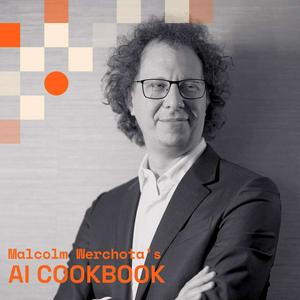
Malcolm Werchota's AI Cookbook Show is where artificial intelligence meets authentic business transformation. Known for his direct style and willingness to show AI in action—even during live presentations—Malcolm helps organizations understand that AI isn't about replacing humans but amplifying their capabilities. From voice-note productivity hacks to real-time meeting intelligence, this podcast delivers actionable insights for immediate implementation.
Strona internetowa podcastu

Słuchaj The AI Cookbook Show by Malcolm Werchota, Nowoczesna Sprzedaż i Marketing i wielu innych podcastów z całego świata dzięki aplikacji radio.pl

Uzyskaj bezpłatną aplikację radio.pl

  • Stacje i podcasty do zakładek
  • Strumieniuj przez Wi-Fi lub Bluetooth
  • Obsługuje Carplay & Android Auto
  • Jeszcze więcej funkcjonalności
The AI Cookbook Show by Malcolm Werchota: Podcasty w grupie