
Słuchaj tego podcastu za darmo w aplikacji: Pobierz za darmo z App Store
radio.pl
Sleep timer
Zapisz stacje
51 odcinków
Sovereignty, Data and Code: Who's in Control?
21.10.2026 | 34 min.Throughout history, statecraft was defined by borders, battlelines, and territory. In the 20th century, global power shifted to financial capital and energy reserves. Today, with the digital revolution well underway, does real authority now belong to those who control our data and code?
And what does sovereignty now mean in a fast changing AI landscape? Back in the day it used to mean keeping data in a local server room. But today, frontier AI models are advancing at pace, some argue at a speed we can’t control and regulatory lines are being redrawn across the world to try and keep up.
Governments and boardrooms now face a fundamental question: who’s controlling who? And what can we do about it?
Joining host Tom Parker is Charlie Giancarlo, Chairman and CEO of Everpure, Sana Khareghani, Chief Strategy Officer at Era4, Professor of Practice in AI at King’s College London, AI Policy Lead for Responsible AI UK and Former Head of UK Government Office for Artificial Intelligence and Clare Schramm Fergus, Managing Director, Transaction Banking Technology Platforms, Lloyds Banking Group and Board Member of OpenUK.
Sources: FT Resources, Wired, TAIDE, Tony Blair Institute for Global Change, UK GOV Sovereign AI Fund, Politico
This content is paid for by Everpure and is produced in partnership with the Financial Times' Commercial Department. The views and claims expressed are those of the guests alone and have not been independently verified by The Financial Times.
Hosted on Acast. See acast.com/privacy for more information.Systems Rewritten: Automotive
13.10.2026 | 37 min.Imagine it’s 2006, not 2026. You’re an automobile factory manager, looking at combustion engine vehicles moving through the assembly line. A sight that has been seen since the Model T Ford, a century earlier.
Today, you’re still watching legacy internal combustion engines roll off one side but high-voltage battery packs drop into electric chassis on the other. Electric vehicles could account for just over a quarter of global new car sales this year and as much as half of light vehicles sold worldwide by 2035. 5 years ago, it was just 9%.
Across the industry, the ground is shifting under automakers' feet. Yet the rumbling is being felt much more in some countries than others. The map of ICE (Internal Combustion Engine), EV and autonomous dominance is being rewritten.
Joining host Tom Parker is Niall Healy, Chief Operating Officer at Trade Nation, Marc Palmer, Head of Strategy & Insights at Autotrader and Professor Peter Wells, Professor of Business and Sustainability, Centre for Automotive Industry Research, Cardiff Business School.
This episode was recorded on 23rd September 2026.
Sources: FT Resources, IEA, Bloomberg NEF, SQ Magazine, CPCA, ITA, Mercedes Benz, Road to Autonomy
This content is paid for by Trade Nation and is produced in partnership with the Financial Times' Commercial Department. The views and claims expressed are those of the guests alone and have not been independently verified by The Financial Times.
Hosted on Acast. See acast.com/privacy for more information.Systems Rewritten: AI
06.10.2026 | 42 min.Supply and demand. The foundational backbone of market economies. And we’re in the AI era, where demand and supply is being rewritten.
Behind this AI revolution, sits a monumental physical buildout and energy demand. Globally, data centre power consumption will double by 2030 toward 945 terawatt-hours, consuming more power than the entire nation of Japan.
In some regions the strain is already visible: data centres accounted for more than a fifth of Ireland's national electricity consumption in 2022 and predicted to reach nearly a third this year. Stateside, in 2023, when less powerful models existed, roughly a quarter of electricity use in the US state of Virginia was sucked up by data centres. And yet, McKinsey estimates that there will still be $7tn in global data-centre infrastructure investment by 2030.
Then come the Hyperscalers, Alphabet, Amazon, Meta, Microsoft and Oracle who are expected to spend around $670bn on AI-related capital expenditure this year alone, and nearly $800bn next year. The nine largest AI companies have collectively forecast $4.1tn in capital expenditure through to 2030, a trillion dollars more than the total 2025 Capex of all US non-financial companies combined.
So looking at systems being rewritten, are we witnessing the greatest industrial re-tooling in human history, or is it all too much to handle?
Joining host Tom Parker is Matthew Wright, Chief Strategy Officer at Trade Nation, Walter Pasquarelli, Researcher at Cambridge University and OECD advisor, and Bernard Marr, Author and Futurist.
This episode was recorded on 16th September 2026.
Sources: FT Resources, McKinsey, Goldman Sachs, OECD, TTMS, IEA, Hungyichen, SIA
This content is paid for by Trade Nation and is produced in partnership with the Financial Times' Commercial Department. The views and claims expressed are those of the guests alone and have not been independently verified by The Financial Times.
Hosted on Acast. See acast.com/privacy for more information.Systems Rewritten: Markets
29.09.2026 | 38 min.It’s Q3 2026, the systems that form the global economy are currently being rewritten by the digitally led, fourth industrial revolution and the geopolitical repositioning of power. You’re an investment banker, a portfolio manager or a retail investor looking at trading screens flash red and green. There’s a hive of activity. But what to make of it.The indicators continue to flash, but the signals are conflicting.
On one side sits the bull case: real AI driven corporate revenue, strong earnings, record stock prices and the unprecedented cash flow of the Hyperscalers.
On the other side sits the bear case: historically concentrated index valuations, an ever widening gap between monetisation and infrastructure spending, and an increasingly fragile global debt landscape.It leaves you, as well as other investors, economists, and central banks asking some big questions: Are we witnessing a durable, tech-driven productivity shift? A once in multiple generation opportunity to transform individual, corporate and societal wealth? Are we re-writing the whole world economy? Or are we sitting giddy and foolishly riding a teflon-coated bubble that will soon burst?
Our host Tom Parker is joined by Jon Noble, CEO of Trade Nation, Russ Mould, Investment Director at AJ Bell and Karen Ward, Chief Market Strategist for EMEA at J.P. Morgan Asset Management.
This episode was recorded on the 22nd of September 2026.
Sources: FT Resources, Harding Loevner, RBC Wealth Management, Slick Charts, Yahoo Finance, Macrotrends, OECD, AI Weekly, IMF, CNBC, IIF.
This content is paid for by Trade Nation and is produced in partnership with the Financial Times' Commercial Department. The views and claims expressed are those of the guests alone and have not been independently verified by The Financial Times.
Hosted on Acast. See acast.com/privacy for more information.Code and Conscience: Intelligence Within and Without Borders
24.09.2026 | 47 min.Sovereignty, by definition, is being updated. Sovereignty 2.0. Under geopolitical tensions, supply chain dependencies and competing regional regulations, the discussion around digital sovereignty is shaping where you're allowed to build, what models you’re allowed to train on, and who's allowed to see the results.
Competing lines are being drawn. On one side there are those calling for the democratisation of AI and opening the global doors to innovation. On another is a fragmented map of regional regulations, like the strict mandates of the EU AI Act.
Bubbling underneath is the geopolitical chess match, primarily between the US and China, turning data, frontier models and the infrastructure behind them into a matter of national security.
All of this offers up some big questions for governments and businesses. One no bigger than this: Can global enterprise innovation really survive in a world of digital borders?
Joining host Tom Parker is Stéphane Israël, Managing Director of the AWS European Sovereign Cloud and Digital Sovereignty at AWS, alongside Ali Ustun, Senior Partner from McKinsey’s Middle East Office and co-leader of their global Data and AI Foundations Service Line and Dr. Catherine di Lorenzo, Partner at A&O Shearman.
Sources: FT Resources, McKinsey, NASA
This content is paid for by AWS and is produced in partnership with the Financial Times' Commercial Department. The views and claims expressed are those of the guests alone and have not been independently verified by The Financial Times.
Hosted on Acast. See acast.com/privacy for more information.
Więcej Biznes podcastów







Trendy w podcaście Biznes



















O The Next Five
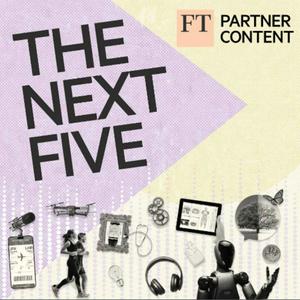
The Next Five is the FT’s partner-supported podcast, exploring the future of industries through expert insights and thought-provoking discussions with host Tom Parker. Each episode brings together leading voices to analyse the trends, innovations, challenges and opportunities shaping the next five years in business, technology, health and lifestyleThis content is paid for by advertisers and is produced in partnership with the Financial Times’ Commercial Department Hosted on Acast. See acast.com/privacy for more information.
Strona internetowa podcastuSłuchaj The Next Five, Think Fast Talk Smart: Communication Techniques i wielu innych podcastów z całego świata dzięki aplikacji radio.pl
Uzyskaj bezpłatną aplikację radio.pl
- Stacje i podcasty do zakładek
- Strumieniuj przez Wi-Fi lub Bluetooth
- Obsługuje Carplay & Android Auto
- Jeszcze więcej funkcjonalności
Uzyskaj bezpłatną aplikację radio.pl
- Stacje i podcasty do zakładek
- Strumieniuj przez Wi-Fi lub Bluetooth
- Obsługuje Carplay & Android Auto
- Jeszcze więcej funkcjonalności

The Next Five
Zeskanuj kod,
pobierz aplikację,
zacznij słuchać.
pobierz aplikację,
zacznij słuchać.
 Polska

