
Słuchaj tego podcastu za darmo w aplikacji: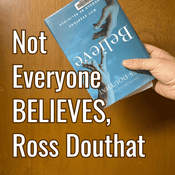 Pobierz za darmo z App Store
radio.pl
Sleep timer
Zapisz stacje
26 odcinków
The Work That Demons Do For Ross Douthat
30.10.2026 | 12 min.Demons are no more real than the Christian god is. Nonetheless, Ross Douthat has summoned demons to do his dirty work.
Welcome back to Not Everyone Believes, Ross Douthat.
I said at the beginning of this podcast, in the first episode, that we were going to be going page by page, line by line, and okay, I'm not examining every word of Ross Douthat’s book, but boy, he just packs in a whole lot of nonsense very densely.
If you're just hearing this podcast for the 1st time, let you know what book it is that we're talking about. We're talking about a book by Ross Douthat, who is formerly from the New York Times, as an opinion writer. He's really just a professional pundit. He's now with 60 Minutes, which is controlled by Donald Trump and the Republican Party. Now 60 Minutes has become an ideological kind of rag on the television.
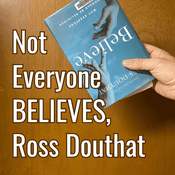
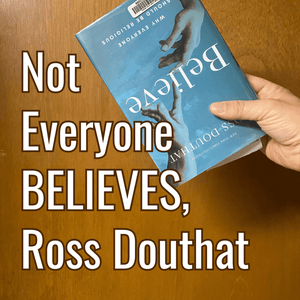
Ross Douthat is the author of the book Believe: Why Everyone Should Be Religious. We are now in the 4th chapter and we're at the bottom of the page, 119.
Today's episode is going to be brief because I'm just talking about one paragraph. This one paragraph shows how nonsensical. Ross Douthat’s whole perspective is and what it's really all about. It reads like this:
“For some, a small but meaningful minority, welcome is the straightforward answer, and if you're setting out to discover Satanism, then you probably aren't going to be talked into joining a more mainstream faith without some hard experience first, but other spiritually mind open-minded people experience a chronic uncertainty about how to handle negative encounters, and the mere appearance of the dark or negative or devilish, no less than the appearance of a ghost or monster in the horror movie isn't by itself enough to convince them, not to keep opening doors and looking into basements and wandering down corridors that might be better left unexplored.”
This paragraph at 1st appears just to be about monsters and demons, devils, dark things, negative things, going places, they're not supposed to go, thinking things are not supposed to think doing things that are against the rules of God.
We all know that monsters don't exist. Devils, demons, ghosts, they don't actually exist. There's no evidence for them.
If at this point, you don't get that. I really don't know what to do with you because there's no photographs, there's no, you know, genetic samples from them, no videos, and we have so much research equipment that's all around the world right now, that if there were ghosts and demons and monsters showing up, We would see them. We would see them. They're not there.
Why is Ross Douthat talking about these imaginary magical creatures? Yes, it is ridiculous and irrational for him to believe in these things. Nonetheless, they are doing work for him. Ross Douthat’s writing in this paragraph shows us what that work is.
First of all, when it comes to Satanism, Ross Douthat doesn't even bother to engage with what Satanism actually is. Satanists don't believe in gods. They don't believe in the literal reality of Satan. They believe in actually kind of a more atheist approach.
Satanists use Satan as a symbolic character to represent independent thinking and rebellion against tyranny, against authoritarianism that is represented by the Christian God. The Christian god is a tyrant, an authoritarian. The Christian god set up a world that's full of death, that's full of misery and suffering.
Of course, no, God hasn't really done these things, because God doesn't exist. We're talking about God as a character.
God is a symbol of kingship. That's why Christians love calling their god the “King of Kings, the Lord of Lords”. The Christian god is a monarch. It’s an authoritarian tyrant that Christians are worshiping.
Ross Douthat says that you need to worry about demons because they're negative. Negative sounds so, you know, bad. It sounds so wrong.
But hey, wait a minute. You know what negative really is? Negative is the right to say no. Negative is the right to set boundaries that other people are not allowed to cross, when it comes to your own life.
Being negative enables you to say no, you're not allowed to touch me in that way., no, you're not allowed to take my things, no, you're not allowed to come into my house in the middle of the night and bother me, no, you don’t have the right to tell me who to love and how to live my life.
The thing with Christians like Ross Douthat Is that they're terrified by other people saying no to them. They are terrified by other people rejecting the beliefs that they believe everyone must have, as Ross Douthat said earlier in this book when he talked about the obligation of religious belief.
Ross Douthat believes that obeying the kingship of his god, the cosmic dictator, is the only way that you can save yourself from being tortured by that same god. That's what the Book of Revelation is all about. That kind of punishment after death was not there in Judaism. That's something that was invented by the followers of Jesus. Christianity invented the threat of Hell and divine torture. They invented a sacred cult of pain as a manifestation of their worship of tyranny, of the power of one monarch.
Christianity is the worship of monotheism. Monotheism is mythological monarchy, mythological dictatorship, authoritarianism with magical beings.
With that, along come those devilish characters. What do the devils and the demons represent? In Christian cosmology, they represent angels who said no to God.
They said, no, we don't like what you're doing, and we're going to make our own choices. To punish them God, tried to kill them all, and tortured them and imprisoned them. We're supposed to be afraid of the demons, but all this while, God is still threatening us with torture if we don't obey.
Again, remember this isn't really happening. There are no gods. There are no demons, there are no devils. So, what is the actual project?
The actual project is an ideological system that supports totalitarian dictatorships that supports tyrannical kings, queens, monarchs, the idea that power should be concentrated in the hand of one person.
The role of everybody else is not to question is simply to obey. Look at what is happening in the United States of America right now. It’s a Christian restoration of ugly, ruthless authoritarianism.
It's not for nothing that Ross Douthat fails to even try to engage with the idea of Satanism as it actually is, as a metaphorical kind of social movement.
Satanists don't believe that Satan is real or gods are real. What they believe in is the value of independent thinkers.
All that Ross Douthat says about Satanism is this:
“If you're setting out to discover Satanism, then you probably aren't going to be talked into joining a more mainstream faith.”
It’s telling that Ross Douthat only supports mainstream faith. Conformity is what his Christianity is all about. It's all about getting everybody to do the same thing, the thing that human priests and human dictators want you to do, what they tell you to do. Conform. Obey.
He's simply deciding that Satanists aren't going to be convinced.
Well, has he even tried to reason with Satanists? Has he even tried to actually talk with them?
Ross Douthat doesn't want to construct any rational arguments against Satanism because in order to do that, he would have to publicly acknowledge what Satanism really is, not what the Catholic Church says, it is.
If Ross Douthat were to do that, he would have to acknowledge that Satanists are rebelling against tyranny, that they're standing up for freedom, the freedom of people to think as they want to, to act as they want to, without cruelty. They're standing against the concentration of power in the hands of a few.
Ross Douthat doesn't even engage in a rational discussion with that idea. Once again, he's betraying the promise that he made at the beginning of the book.
Ross Douthat is not being an honest writer. He is not being an honest thinker. He's simply using scare tactics.
He's comparing independent thinkers, skeptics, atheists, and nonconformists to monsters. He is saying that they are actually in league with real monsters that literally exist.
Ross Douthat is doing that in order to scare you, to intimidate you, so that you stop thinking for yourself. It's a really cheap trick.
That's why not everyone believes, Ross DouthatWhy Not Believe God Is Bad And Demons Are Good, Ross Douthat?
28.10.2026 | 22 min.Ross Douthat writes about why you ought to belong to not just a religion, but to a church. Religious belief in itself really isn't the goal for Ross Douthat. Belief is part of what he'd like you to do, but really what's much more important is that he wants you to belong to a religious organization. Organized religion, he says, has benefits. We’ll get to one of those.
On page 118, Ross Douthat is trying to do away with an objection to what he's talking about. He is dismissing one of the most frequent criticisms of organized religion.
Even for those people who believe in magic and the supernatural and gods, spirits, you know, fairies, stuff like that. They will point out that organized religion is pretty vapid. It's pretty empty. It's filled with a lot of people who really can't be trusted, um, who who don't do what they preach, all of that morality that Ross Douthat was talking about. A lot of people in organized religion end up doing a lot of immoral stuff.
On page 118, Ross Douthat is arguing against that. He is acknowledging, “Certainly, in a society where professed faith is a default, and almost everyone is participating in a religious tradition, there is a grave temptation toward hypocrisy, fake piety, the kinds of empty spiritual practice that the world's great religions warn against, almost as often as they warn against active impiety, or unbelief, and there are certainly communities in our own society where this socially conditioned pretense of religion still exists, but in most regions of contemporary culture, and certainly for most people hesitating on the threshold of religion, the dangers of hypocrisy and fake piety are relatively distant ones, while the dangers inherent in spiritual individualism are more immediate and pressing. If your reason for avoiding institutional religion is the fear of the Inquisition or the Salem witch trials or even just the stifling atmosphere of some pre Vatican II Catholic parishes or Protestant small towns, you are letting a danger that's increasingly remote push you away from the things that are necessary to mitigating today's perils, today’s problems, isolation rather than Pharisaism, narcissism, rather than authoritarianism, a world that leaves you alone in despair, rather than a society that's always nosing in your business.”
Ross Douthat is saying that if you're worried about religious authoritarianism, well, that's just a distant concern. That's not a big deal.
What you need to worry about is people doing what they want and just being individuals. That's the real threat.
I’ve got to ask you something: If you take a look at what's happening in the United States of America, do you really think freedom and individualism is wrecking this country?
We're about to have an election, a midterm election. Donald Trump is not on the ballot because it's not a presidential election year, but it is a de facto kind of test of his popularity, because a whole bunch of Republican members of Congress who have been giving Donald Trump pretty much everything that he wants, letting him do whatever he wants, not holding him to account.
They're up for election now, and in republican majority districts as well as democratic majority of districts, those Republican candidates are profoundly unpopular. This is one of the most stark anti-Republican voting moods in the electorate in a long time. In about a week and a half, I guess about a week, it's happening soon. We're going to see exactly how far that rejection of Donald Trump is going.
I just did early voting today, and if you live in a Democratic majority area where you can trust the Board of Election not to do shenanigans on behalf of Donald Trump, I encourage you to do early voting. Get it out of the way, make sure that it's not difficult for you to do voting. That's what early voting was set up to do to empower people, to empower democracy and the freedoms that it protects, which is why Donald Trump hates it so much.
Donald Trump also hates Donald Trump hates when people reject Christianity. He is so into Christianity and he talks about it all the time. You know Donald Trump was raised in a Christian church.
A lot of people say that Donald Trump has never set foot in a Christian church in his life. That's not true. The church that he went to when he was a young lad, and the one where he got his religious confirmation, there are photographs of him in that church.
You know what that church did? It forbade, it outlawed, it banned African-American couples from being members of the church. That church taught hatred. That church taught Donald Trump that religion and discrimination and oppression go hand in hand and you should use religion as a tool of oppression, of discrimination, of inflicting suffering on your enemies. That's the kind of Christianity that Donald Trump was raised on, and that's exactly what he's doing today.
We have a Christian Nationalist government that is taking food away from hungry people, not just here in the United States, but around the world. We have a country that is waging war, is encouraging war, that is threatening Greenland, is threatening Canada. We're bombing schools.
We're driving prices up. Donald Trump recently said, well, the oil companies are making a great profit on the oil, so what if the American people have to pay a little bit extra? That is the voice of Christian Nationalism.
Donald Trump is the same guy who's saying, yes, we're a Christian nation now.
He said that If I'm elected, you're going to have Christian visibility, this is going to be about showing what Christian Americans are really all about. Trump had the support of the majority of Christian voters in America, and you know what, he still does.
There's a Pew Research poll that shows that only one third of Christian Americans are planning to vote against Donald Trump's Christian nationalist fascist agenda.
We have people being shot dead in the streets by secret police. We have electronic surveillance all across the country being set up under a Christian nationalist authoritarian regime. We have concentration camps in which people are dying, in which people are being disappeared, children being separated from their parents. People are being shipped off to countries they've never been to, where people speak languages that they don't know, where there are yet more concentration camps.
This is being done in the name of Jesus, in the name of God, and yet, Ross Douthat is saying that there's not any big risk of any kind of religious hypocrisy, no religious danger. No religious authoritarianism. It's not a risk. He's saying it's just not happening.
Take a look at what's happening with digital fascism, the way that you're being watched all the time, not just with those flock surveillance cameras, but through your phone, through your activities on the web, through everything that you buy, every kind of electronic communication that you have. It's being swept up by the government and by corporations.
This is all being done to create a religious authoritarian state. At the same time, Ross Douthat is saying here on page 118 of his book, Believe, that the real risk is that you're free to be an individual who makes your own decisions about what you believe and what you don't. That, to me, is absolutely shocking.
There's something that Ross Douthat said at the end of this, that what the real danger is, what today's perils are really all about. Over on the next page, we have a new section of this 4th chapter. This new section is called Not Every Door Should Be Opened.
What is it about? You know what it's about?
It's about demons.
Yeah, we have Donald Trump wrecking, threatening to take away your right even to vote in the United States, absolutely ruining American democracy and replacing it with a corrupt kind of authoritarianism that is defined by Christianity.
Now Ross Douthat says that's not the big deal. What you need to worry about, says Ross Douthat, is demons.
I'm going to read to you a little bit of what Ross Douthat has to say about the demonic threat in his own words.
“Institutions offer spiritual protections that aren't available on your own. If the supernatural is potentially real, it is also potentially dangerous with more substantial stakes than most interactions in the natural and the everyday. Part of the point of the evolved technology of organized religion is to provide safety and security to travelers in this landscape to connect a secret to cosmic powers that are friendly to the human race, to help discern the difference between experiences worth pursuing and roads best left untaken, and to provide direct protection against the forces and experiences that seem destructive and demonic. ‘Don't mess around with demons’ might seem like too basic a message to require the structure of an entire religion to convey and reinforce, but in fact, what happens in horror movies, the people who go into that room or open that book or hold that seance, with predictably disastrous consequences, also happens in real life.”
Ross Douthat is saying not to worry about the technologies of Christian Nationalist authoritarian fascism to spy on your life, to send out fake messages and propaganda, to manipulate you, to control you. Don't worry about the way that Bitcoin is being used for public officials like the President of the United States to take massive bribes, so that only rich people get what they need and everyone else has to do without.
You know what that's about. The rising prices don’t come from nowhere. Inflation comes from Christian nationalist fascism and the political corruption that undergirds that and undermines our democracy.
No, no, Ross Douthat is saying, don't worry about that, because what's important is that the Catholic Church has technologies, religious technologies, to protect you from demons. Do you know what religious technologies he's talking about? He's talking about exorcisms and sprinkling holy water on you.
Ross Douthat is saying, you need to belong to a church so that you can have guys in funny costumes mutter Latin phrases that are magic somehow, and sprinkle holy water on you, to protect you from demons, because demons and evil spirits are what you need to be worried about.
Ross Douthat is saying that all the scary monsters in horror movies are real, but fascism is not real.
Ross Douthat is saying also that if you are a Christian, but you don't belong to a church, and the right church, the kind that practices exorcisms, like the Catholic church, well then, you don't get any protection.
When he's talking about friendly cosmic powers, Ross Douthat said that the role of Christian churches is to introduce you to, “cosmic powers that are friendly to the human race.”
Who is he talking about? Who are the cosmic powers that are friendly to the human race? Is he talking about the Christian character that they call God, Jehovah, Yahweh? Is that the guy who is friendly to the human race?
Do I have to remind you what the Christian Bible says that God did to people in the past? Of course, there's the Book of Job, in which God thought it would be fun, just to prove a point, to torture a man for years and years and kill his family and make him absolutely miserable. That was fun for God.
Earlier, God encouraged genocide of entire cities of people just because they didn't worship him. God didn’t just provoke nasty battles in which a lot of soldiers got killed. God encouraged his followers to go and kill babies.
Are you pro-life? How can a person say they're pro-life and be pro-Bible? I wonder about that.
In the book of Genesis, where God decided, even though he made people, he didn't like them very much. God decided, “I’m going to kill them. I'm going to kill them all. I'm going to keep just one family together, and they're going to interbreed with each other and commit acts of incest to repopulate the earth, but I'm going to kill, kill, kill, kill. I'm going to drown everybody.”
This is the character that is supposed to be a “cosmic power that's friendly to the human race.”
Then we go to the New Testament. It’s not accurate to say that the Old Testament was brutal, but Jesus was all about bringing peace and love and changed everything to make it nice. That's not how it ended up, because actually, in the Gospels, Jesus repeatedly threatens genocide against anyone who refuses to worship him. He says to entire cities of people that they’re going to wish that they had worshiped him and not turned him away and not refused to worship him as a god king, because Jesus is going to commit acts that are worse than what was done against Tyre and Sidon. Tyre and Sidon were two cities that were destroyed in genocides.
In these passages, Jesus is saying, effectively, I'm going to kill you. I'm going to kill you all if you don't worship me, and it's going to be worse than those genocides in Tyre and Sidon.
People say that Jesus told all these lovely parables. Do you know the parable that he told about the king who rightfully ordered people to be brought in front of him and to be executed? Jesus said, I'm gonna be like that king.
Elsewhere, in the gospels, Jesus said, don't think I've come here to bring peace. I have come to bring a sword and divide people. Jesus came with a sword, and he said that, if you don't hate your own children in order to love me better, you're not a follower of me. Jesus actually preached hate.
Then there is the Book of Revelation. The Christian churches included Revelation in the Bible because it threatened bloody annihilation to everyone who is not a Christian. That part of the Bible threatens massive death and destruction with the approval of God, so that God will kill almost everybody on earth. Jesus announces that he will kill people in really nasty ways, torturing them first, and then bring them back from the dead, and then torture them more, just because they're not Christian.
Ross Douthat says that Christian churches are there for introducing you to that guy, that killer? Why? Because you need protection from demons.
It says in the Book of Revelation that it's God who's bringing on the monsters. God is bringing on the monsters.
Ross Douthat is talking about demons. He's saying that these monsters are real, but there's no evidence that demons actually exist. There's no evidence that angels exist. There's no evidence that gods exist. No evidence. None. Not a single bit.
There's nothing more a bunch of stories that Christians like to tell about this supernatural stuff. They’re the same kind of stories that people used to tell about Medusa and the cyclops and minotaurs and centaurs and griffins. People used to love to tell those stories, and some people believed that they were true. We now know that they are not true. In the same way, demons are not real.
Let's speak from a perspective of reality for a second here. If God is such a nasty person who is constantly torturing and killing people, and blaming them for what he's done, never taking responsibility, making people suffer pain because of God's own mistakes, if that's real, and you think that that's real, why do you think that demons are the real problem?
Maybe demons aren’t the biggest you have to deal with.
I want Ross Douthat to address this point, because he said he's going to be reasonable. He promised to be logical and said he was going to be writing based on the facts that we can gather from our own senses.
What are the facts that prove that demons are dangerous and evil and to be avoided? What is the evidence?
I'll tell you. Ross Douthat provides zero evidence that demons are dangerous and evil.
We are at page 119 of his book, out of what is barely more than 200 pages. There are just 206 pages of content in Ross Douthat’s book. We're over halfway through, and Ross Douthat hasn't provided any evidence that any of these magical creatures even exist, much less identified any evidence for what kinds of personalities different magical creatures have.
Maybe demons are the good guys, because God's kind of a jerk. Do you want me to feel differently about that? Do you want me to ignore fascism so that you can protect me from magical creatures that you can't even provide evidence for? Why would any sane person go along with that?
Ross Douthat can't vouch for their character of demons being evil anymore than you can vouch for the character of his god and the angels being good.
Ross Douthat has provided us with nothing to go on here. Zero.
That is why Not Everyone Believes, Ross Douthat.
Not everyone believes.Why Should I Let A Church Tell Me How To Live, Ross Douthat?
27.10.2026 | 15 min.On page 117 of his book Believe, Ross Douthat suddenly announces that people should submit themselves to the moral commands of Christian churches. Why? Ross Douthat has provided no rational reason to think that religions have any moral authority. He just takes it for granted.Why Join A Christian Church If You’re Not Hot For It, Ross Douthat?
27.10.2026 | 22 min.We are at page 115 of Ross Douthat’s book, Believe: Why Everyone Should Be Religious, but we are also referencing back to page 112, because it's really confusing to me to try to figure out exactly what the author Ross Douthat is getting at here.
Ross Douthat has said a lot of really judgmental stuff about how very important it is that you be a member of the right religion, we've talked about how Ross Douthat is referencing the Book of Revelation, in particular on page 112, where he says it's “better to face the consequences of even a mistaken commitment or decision than to hear at the last the fateful judgment, ‘Because you are lukewarm, neither hot nor cold, I will spit you out of my mouth.’”
That's a quote from the Book of Revelation, in which Jesus is saying over and over again, I'm going to kill everyone on earth who refuses to submit to my authority and worship me as a god.
It’s not a little mealy mouthed thing; Submit to my authority or die, and I might well torture you for five months straight. Seriously, that's one of the tortures of the Book of Revelation, and that torture not coming from demons. It's coming from an army of angels that is released by an angel who was sent by Jesus.
God sent this army, this army of monsters to earth, or that's the prediction, maybe, of what's going to happen. God is going to send these monsters who are scorpions in the tail, but they have the body of locusts and the heads of human beings with crowns and metal armor and long hair and sharp teeth, and they'll sting you and the sting will give you utter agony for five months straight, and people will beg the angels of God to please just kill them to end the agony.
The Bible, the New Testament says, no, Jesus is not going to allow that. Jesus is going to force people to suffer for five months straight because he doesn't want to give them relief from their pain because they have refused to worship him. That's some pretty serious stuff.
Now, on page 115, there's this on the other hand, from Ross Douthat
He says, “This submission,” this submission to Christianity, “doesn't require total certainty about the tradition you're joining. Some religions explicitly allow for all kinds of uncertainty, just as modernity has multiplied religious options, it has also multiplied religious institutions that try to accommodate the uncertain pilgrims. This accommodation might be more extensive in a tradition like Hinduism, with its extreme multiplicity of schools, than in the more dogmatic traditions of the West, but the liberal religious programs in Christianity and Judaism exist, in part, to offer the benefits of Western monotheism, to people who aren't sure about all its doctrinal claims or communal. Requirements, to offer general maps to questers who aren't sure about the entire guidebook.”
Ross Douthat is saying, well, you can join Christianity, just join one of these churches that doesn't require you to have all of the rules of Christianity. They're more lax about it in these parts, and Hindus, they let you do pretty much anything.
First of all, Hinduism isn't always really that low key about things. There are Hindu nationalists, and Hindu fundamentalists who are pretty hardcore, and engage in acts of mass religious violence against Muslims, for example. Let's not play around with those non-Christian religions, all right?
There are religious traditions that are more low key and easygoing.vThere are Quakers, although Quakers sometimes, they can be nasty sometimes.
There are Unitarian universalists, yes, but here's the thing. Isn't belonging to that kind of congregation just saying, hey, believe whatever you want to believe about, religion and Christianity and Jesus and all that stuff or something else, even if it's not Jesus, it's all okay?
You know, you figure it out. You go at your own pace. Isn't that exactly what Ross Douthat was saying you must not do, when he's talking about how you can, you shouldn't be lukewarm?
You shouldn't be in between, he said. You should be hot, or you should be cold. You should not believe something, or you should believe it very strongly. That's what that's Ross Douthat was saying just two pages ago, so that's kind of confusing.
Now, earlier on page 112. Here's what he says. He's trying to kind of have it both ways. He's saying, well, maybe you start out. You start out just anything goes, whatever, just get into church.
So, what Ross Douthat says is, “As a starting place for someone with no definite ideas about religion, beyond the sudden realization of its importance, there is nothing wrong with this approach,” the approach of just, you know, remixing religion and personalizing it for yourself, taking what you like and not taking the other parts. He continues, “Just as you wouldn't expect someone newly introduced to the concept of politics to immediately become an ideological activist or someone unexpectedly dropped into a novel PhD program to become immediately bound to a single interpretive school, becoming newly interested in religion, should at first be a mind opening experience, a chance to explore without prejudice, to take ideas seriously without the temptations of team spirit, and not only ideas, but experiences, different forms of communion, of worship, of prayer.”
Of course, Ross Douthat is also saying, oh, well, don't accept atheism that way, wth that kind of open mind? Remember what he wrote earlier? He said an open mind is not a good idea. You actually want to close your mind. “Open-minded, open-mindedness is not necessarily a virtue.”
That's where he talks about not being lukewarm. So Ross Douthat is kind of all over the place.
What it really looks like to me is that Ross Douthat is trying to say that there is an absolute right and wrong, and that there is a right religion, and there is one true path, and you can't do multiple paths, and you can't just say, oh, I'll be a Hindu today, and a Christian tomorrow, and you can't just take the parts of Christianity that you want. There is truth and God wants you to be absolute and on fire for religion.
But hey, Ross Douthat also wants people to become Christians. So, at this point, Ross Douthat seems to have a two-step process. Ross Douthat wants to get you in the door. He wants to sell you on Christianity.
Then, once you get comfortable, at first, you’ll get love bombed by everyone and everyone will be saying, oh, hey, don't hurry yourself, don't commit. Why don't you just try things out and see if our church is for you? Come on back, have a cup of coffee. We're so happy to have you.
Then as you go on further, people are going to start to make demands. Isn't that the experience that people have with church? It starts out with, oh, we're open-minded and everybody's on a path, and then you go to the Book of Revelation idea. You’ve got to be on the team. You’ve got to be all for it. You’ve got to be for the church, and you've got to obey our rules, and you've got to change your life, or you're not on the team, and you're either with us, or you're against us.
It's a bait and switch. It's a classic bait and switch. It's the kind of thing that happens to people going into church all the time.
I wanted to read something else to you from Ross Douthat’s book, though, because it also lets you know a little something that lies underneath that absolute obedience.
Ross Douthat starts to talk about his own church, the Roman Catholic church. This is, again, on page 115 in the middle.
“The more conservative confessions, ask more of their practitioners. My own Catholic church expects converts to profess fidelity to all the church believes and teaches, but in practice, they too are filled with people who maintain private heresies, or private doubts, who feel agnostic 2 days out of 7, but who have made the sensible decision, that it's better, better to live inside the tradition they consider most plausible while holding doubts than to reject. In the name of those difficulties.”
Okay, so what Ross Douthat is saying here is that actually, the Roman Catholic Church is full of a bunch of people who don't really believe what the Roman Catholic Church teaches. They have doubts. They have skepticism. They think that a lot of what the Roman Catholic Church teaches is complete BS.
But do you know what they do? They don't talk about it. They don't share it. They don't go public with their doubts, their skepticism. They are decent people who keep their thoughts quiet and to themselves and pretend that they believe fervently just like everyone else.
This is what Ross Douthat claims is a virtuous church, one in which people are dishonest, one in which people lie about what's really on their minds, one in which people imitate faith, pretend to have faith, to go along with the crowd, to go along with community.
I just want to point out that this is in direct contradiction to the promise Ross Douthat made at the beginning of this book, that he was going to give us a rational, reasonable basis for belonging to a religion and for believing in that religion, not for posing with a religion. The thing about rationality, the thing about reason and logic, is that it has to be debated and discussed. If you are rational with your suspicions, with your thoughts, you need to be able to talk about them.
It's not rational to have skepticism to have doubts about the truth of something and then to just shut up about it and not talk about it. That's the opposite of rationality.
That is a herd mentality, which is the metaphor for Christianity, that you're a sheep. You're a member of the flock, and Jesus is the good shepherd, and you should just be a frickin’ sheep. You don't have to know what Jesus is all doing. You don't have to know what the priests are doing. Just obey.Just go along with it and just trust that it's all okay.
Do you know what a rational animal is not? A rational animal is not a sheep. Sheep are not the animals that are known for their debating and their logical skills, but what Ross Douthat is arguing for is that you just become a sheep, and you can have your doubts, and that's great, so long as you just shut up and you keep them quiet so that you don't disturb the congregation. Ross Douthat is promoting the opposite of rationality.
What’s more, Ross Douthat is not even being biblically consistent about it. Let me go back to page 112 here in chapter 4. Ross Douthat is saying, “You wouldn't expect someone newly introduced to the concept of politics to immediately become an ideological activist.”
Is that what Christianity teaches? There's this little bit from the New Testament.
It's a story of the road to Damascus. Saul is a Jew. He’s a skeptic of all the claims of the Christians that Jesus has risen from the dead.
They ask where's the body?
“Oh, well, he floated up into the sky,” Christians respond. “That's why we can't find the body. That's why he's not walking around.”
Everyone else is saying, “This sounds pretty damn suspicious.” Saul kind of makes fun of Christians for this.
Anyway, Saul is traveling, walking along the road to Damascus and guess what? Wow, Jesus appears to him. Jesus is not like a voice in the wind whispering. He's not there in the form of like a bird that reminds you of something mystical. He’s not indirect. This is certainly not like the story in which Ross Douthat shares that there was a radio playing a love song in the bedroom, and that makes him think that maybe there are ghosts. The story of Saul not that kind of nonsense.
Jesus appears, floating down from the sky, and there are lights. So, in the Bible, Jesus actually appears to people. There's none of this “Does God exist?” Doubt. God just shows up and says hello.
You will notice that in our present day reality, Jesus never appears. Jesus is never ready to have people take a selfie of him. Why is that? Maybe it's because Jesus isn't real, or if Jesus ever was actually a person, he died 2000 years ago.
Anyway, that's just one possibility. I know it's kind of crazy for me to say it, but well, I’m just spitballing here.
Anyway, in the story of the New Testament of Saul on the road to Damascus. Do you know what happens when Saul sees Jesus? He's all in. He falls down to his knees, and he's like, “Wow, I guess you really are real. I can't believe I didn't believe in you. That was really stupid of me. What can I do?”
From that moment, Saul becomes hot for Jesus. He's not lukewarm. He's not cold. He's not tepid. He's not room temperature. He's hot for Jesus. He goes around, and he becomes Paul. He changes his name and everything, and now he's like the Christian’s Christian.
Paul is like, “Yeah, man, I'm so Christian, the whole world has to be Christian.” He spends the rest of his life going around to all of these cities and telling everyone else how they should be the right kind of Christian, and be Christian, and here's how you do it, and here's the right way, and here's the wrong way, and let me write nasty letters to you if you're not getting it right. This idea that, wow, gosh, you can't just expect someone who just learns about religion to be serious about it at first, that's not what the Bible says.
So which is it, Ross Douthat? Do you believe or do you not? What is it that you really want? I think Ross Douthat doesn't actually trust his own religion when it comes down to it. He doesn't trust his own religion.
He's saying you've got to be mealy mouthed about it. He’s saying you can't force people. You can't ask them to commit to believing in things, at least not at first, even though later on the church going to tell them, “You’ve got to do it our way or the highway, or you're going to go to Hell and burn forever and be tortured by the angels of God as the rest of the world is slaughtered all around you.” You will get to that, but he wants to soft pedal it.
He's trying to do market research with religion. Sometimes Ross Douthat thinks that it's truth, and sometimes he thinks it's really just a sales tactic.
When you act inconsistent like that, people notice. People notice that you're not even staying true to your own thing. So why should anyone else want to be true to that, just so that we can join a church and give away 10% of our income in tithing to the church, and watch as our lives get consumed by this organization that begins to demand control over what we do, over who we love, how we live, and how we vote?
Boy, churches are big time political machines now, under Donald Trump. All of that separation of church and state stuff is out the window.
Christianity is running hot and cold at the same time. Choose a temperature! What is it going to be, Ross Douthat? Ross Douthat doesn't seem to understand his own religion.
That's why not everyone believes, Ross Douthat. We don't even know what the hell you're saying.Christianity Is A Map Into Fantasyland, Ross Douthat
24.10.2026 | 22 min.Ross Douthat’s book Believe claims that it can offer a rational argument for belief in religion, but here on page 114, Ross Douthat is now arguing exactly the opposite.
I suppose we shouldn't be surprised by that, because in the second half of his book, Ross Douthat is trying to get you to become a conservative Christian, a Catholic specifically. He's trying to get you to join his religion.
This is taking up half of the book that he promised would not be about promoting one religion over others. So much for honesty.
Anyway, Ross Douthat starts on page 114 with the argument that you should join in with a specific religion, because a lot of other people have done it, qnd therefore, it must be a really good idea. No kidding.
Here’s what Ross Douthat writes: “The better part of wisdom lies in assuming that the web,” the web of ideas within a religion, that the web, “evolved this way for a reason, that there's wisdom to be found in the crowd.”
There's wisdom to be found in the crowd.
Ross Douthat is arguing that you should join a specific religion that has a lot of followers, and you should do that because, well, everybody else must have had a reason for doing it, so therefore, it must be a great idea. Ross Douthat is saying, You know, if all those other lemmings are jumping off the cliff, yeah, you should do it too.
This is a kind of argument that most people mature out of after they've left middle school. Let's say they're 12 or 13 years old. By the time you're that age, you should know better than just to follow along with the herd, assuming that everybody else must have a pretty good reason for doing it. In contradiction to that, Ross Douthat says, you should join a religion and a very specific one, because it's got lots of other members and it's got a long history, and all those other people must have been pretty smart, so you should do it too.
We could spend an entire episode critiquing that. I don't think that you need me to do that.
Instead, we're going to be focusing on another idea that's here on page 114 and 115 in Ross Douthat’s book. That is the metaphor of maps.
Ross Douthat is arguing against the idea that you should just generally accept that religion is true without committing to a particular religion. He's arguing that religions are like maps.
I’m going to read this part to you.
“If you take the optimistic view that all the religious maps, or at least most of them lead to the same destination in the end, lots of people who are moderately favorable to religion, but disinclined to pick one faith and stick with it, offer this justification for their dilettantism. But it doesn't really hold up to scrutiny. Suppose you were in Bangor in 1887, and you wanted to reach Topeka, and you were told that there were five excellent maps, from very different map makers, offering very different itineraries, that would all eventually lead you from Maine west to Kansas. Would it make sense to say, well, since they all get you there eventually, I'm sure I can just draw my own map and get the same result.?Would it make sense to stitch pieces of them together, rejecting the boring or grinding parts of each root on the theory that this way, your journey would be nothing but fun visits to neat roadside attractions? Of course not. If you want to reach Topeka, the fact that you respect all the different map makers equally doesn't absolve you of the requirement to choose one to follow, to submit. This submission also doesn't require total certainty about the tradition that you're joining.”
We'll go on to the next part tomorrow.
This is really weird. What Ross Douthat is arguing is that the last thing you should do.
If you're taking a trip, take a look at the places that you want to go, and then so long as those places are along the general route that you want to take, go to those places.
Ross Douthat is saying not to do that. He is saying that if you're planning a trip, let's say between Bangor, which is a city in Maine and Topeka, which is a city in Kansas, you should not go to the places that you want to go that are between them. Instead, you should follow a route that has been set for you by a map maker, like a map maker would in 1887.
The thing is, in 1887, when they made maps of the roads or the railroads, or maybe you want to go partially by boat on the Great Lakes, whatever, they weren't setting down prescribed routes that you must take between Bangor and Topeka. I don't think that there probably ever was a map that dictated, particularly how to get from banger to Topeka and then telling you which route specifically to go. That's not how maps worked back then. So, already the metaphor is falling apart.
Mapmakers just provided maps of the country with, you know, some of the roads, not all of the roads.
Here’s where you wonder if Ross Douthat has ever actually traveled using a map back before we had these phones, these smartphones with GPS systems. Do you know how people traveled around? They traveled around using a series of different maps. They would have a map for one state, and then they would have a map for the next state, and they would have a map for the next state. They would also have a map for the entire nation that you were in. Those different maps showed things at different scales.
So, we didn't use one map. We used different maps, and often people would have a lot of different maps in the glove compartments of their cars. They would cobble their journey together from different maps, different routes.
Then sometimes people would discover on the way that something happened, like a road was closed. Maybe a bridge was washed out in a flood, for example. So, we adapted, and we might have to go down to Pennsylvania instead of going through Ohio, or something like that. We’ll go ahead and take that route, you know, and we'll change. We will adapt to the circumstances so we don't get set to one specific route.
It's really bizarre, this metaphor that Ross Douthat is using. He is ignoring the fact that everyone had glove compartments with different maps in them, many maps, all at the same time.
Ross Douthat is also ignoring that people, back then before GPS devices, tpretty much just followed the roads and road signs. Road signs would tell you which way way to go. If you wanted to go in one direction in general, you would memorize roughly where the different cities and the different states were, and then you would travel down the road and you would get these signs saying it's this many miles to this city, and then they would say, hey, we're going to have a split here in 10 miles, and if you want to go toward this city, go on this part of the road, and if you want to go on to this other city, take that part.
People wouldn't even use maps all the time. People would just kind of pull off by the side of the road and ask for directions. They'd say, “How do you get from here to there?”They'd ask someone locally who actually knew the landscape. “What's the best place, the best way to get from here to there?”
So, in actual fact, people didn't always rely on maps. They used multiple maps when they had to. They relied on their own observations of the landscape, rather than being dependent on paper maps in the way that we are dependent upon GPS.
I think Ross Douthat when he's writing this, publishing it in 2025, is depending on younger people's ignorance of how using maps actually works. The metaphor just doesn't work. It's not plausible, the idea that you have to submit to one map and one map, only by one map maker, and you have to stick with that one.
And that's his metaphor for religion, that's why you have to stick with one religion, and you can't just pay attention to what's going on with different religions.
The metaphor fails, but also, he's talking about this in terms of religion. Religion is all about, it claims to be about, Christian religion in particular, getting you salvation, which means that God won't torture you.
This is a religion that believes that the default is that God wants to torture you. The creator of the universe hates you, despises you, thinks that you're filthy and awful, just because you're a human being.
By the way, the same religion says that God was the one that created people, the way that they are. Oh boy, that's sadistic, but okay, let's put that little moral caveat to the side.
So the whole idea is that Topeka, the city of Topeka, Kansas, in Ross Douthat's metaphor, is salvation, and God sees that you've been working hard and trying and you've been staying to the one true path, the one true path between Bangor, Maine and Topeka, Kansas. Now you have arrived by that one true path, the one road that's the right road when all other roads are wrong and sinful, and God hates them. When you get to Topeka, yay, you are at one with God, and God shows up and he's there, and he loves you, and everything's great.
Here's the problem: No one has ever been to that kind of place and provided any evidence of it. Nobody has ever been to that Topeka. Nobody has ever been to God, arriving at the destination and taken a photograph of God, or a movie. I mean, we are all carrying these phones around, the smartphones have cameras in them, so, we can take video of God. We could take photographs of God, right? Why does no video or photograph or God exist, then? No one has even gotten like a toenail clipping of God as some kind of evidence that, yes, God is at the end, the destination. Instead, We have a complete absence of the idea of this Topeka actually existing(Topeka being God, and salvation by God). There's no evidence that this place actually exists.
It's not like a map from Bangor, Maine to Topeka, Kansas. It's more like a map of how to get from the city of Bangor Maine, which we know exists, and that's where we are right now, Bangor being reality, and everybody's been there, and there are postcards, and there are books about Bangor main, and there are movies and all kinds of things about it. There is clear evidence that Bangor, Maine exists.
What Ross Douthat is arguing is that you should accept just one map, as the true map, to get you from Bangor, Maine to Atlantis, the lost city of Atlantis on the bottom of the Atlantic Ocean, or maybe it's in the Mediterranean Sea. Maybe it's somewhere else. Nobody really knows, and that's because the lost city of Atlantis is just a legend. It's just a legend that was told in ancient times, a little bit before Christianity was around a few 100 years before that. It even has precedence over Christianity. Compared to the lost city of Atlantis Christianity is the new kid on the block.
It’s an old story that was told by the ancient Greeks, that there used to be this island, and it had a city on it, and it was a lovely, lovely place with a perfect civilization, but then the whole island sunk, because I guess because it offended somebody, some god or something like that, right? Atlantis is a mythical place. It doesn't actually exist. I hate to get everybody down on this, but Atlantis, as far as we can tell, it was not a real place. It was a kind of literary fiction that was used to describe what an ideal society might look like. It was just made up.
So, if you want a map from Bangor, Maine, to the lost city of Atlantis, that's going to be a made up map. Furthermore, it's going to be going taking you down to the bottom of the ocean, and nobody knows how to do that if you’re traveling in a car. What do you do? Get in a submarine to go all the way to your destination? I mean, nobody can do that. Well, I guess maybe the U.S. Navy could do that, but the U.S. Navy has looked around and they aren't seeing any Atlantis.
So this, this religious map that Ross Douthat is describing is really more like a goofy map showing how to get from Bangor, Maine to Atlantis because we don't have any evidence that the lost city of Atlantis exists now or ever was real, and the same thing is true of the Christian God. The same is true of any sort of divine enlightenment with magical beings that can do you special favors, cast magic spells of blessing, or whatever it is that you feel like you need that is supposed to be in the destination of your religious path, right?
Nobody has ever been seen to reach the end of that religious path. In fact, after certain points of that religious path, strictly speaking when you cross over the border between life and death, nobody has ever been seen to go past that and to come back and live to tell the tale.
Ross Douthat’s map shows a path that ends in death, and there's no evidence of where it goes after that.
It's not like a map, really. What Ross Douthat is describing is a fantasy, and you can't map a fantasy.
Now, look, I know Ross Douthat believes that it's true. Nonetheless, the fact is that Ross Douthat promised that he was going to give us rational reasons to believe that this path of his is not just faith. He promised he was going show that his path it's actually a real thing and we have good logical reasons to believe in it.
Ross Douthat has provided no evidence for that.
Instead what he has he told us on this same page is that we should just follow a path that takes you to the lost city of Atlantis, which is underwater, and don't worry about breathing while we’re underwater, because a whole bunch of other people are also on that path, and the fact that there are so many people on that path, walking into the Atlantic Ocean and going underwater to reach the lost city of Atlantis, even though none of them have ever come back, but so many of them have gone there, the number of people walking into the ocean and never coming back shows it must be a good idea, right?
That’s Ross Douthat’s wisdom of crowds. If lots of people think something, it must be true, Ross Douthat says.
That is, of course, the exact opposite of rationality. It's the exact opposite of logic. There's no evidence in Ross Douthat’s argument, no factual basis. It's a map to a fantasy land that doesn't exist.
That's why not everyone believes, Ross Douthat.
Along those lines, there are increasing numbers of Americans who don't believe in Christianity. 60% of Americans are still Christian, but it used to be 80, 85%, 90% maybe, depending on how you measure it.
Increasing numbers of people are stepping away from religion. In fact, Ross Ross Douthat has described some of that dynamic in his book. He's admitted to some of it. He doesn't like to talk about all the details, but he himself complaint that gosh, so many people are leaving religion.
But then, right here on page 114, Ross Douthat is saying that this kind of large scale social shift alone should let you know that maybe it's a good time to leave religion. After all, Ross Douthat claims there is wisdom in crowds, and if lots of people are leaving Christianity, maybe there's a good reason for that. So you should just go along without having to think about it.
That's Ross Douthat’s point of view. I would never promote that point of view.
I would never tell anyone to leave Christianity just because a lot of other people are doing it, and therefore they must all know something and be smarter than you.
That's Ross Douthat's argument, not mine
The argument I want to make with this podcast is that you should actually pay attention to your own eyes. You should pay attention to your own experience.
Don't let people like Ross Douthat bully you into believing. Don't let them tell you that you're too stupid to understand how to get from one place to another, and that they have a magical One Map that's gonna get you from one place to another.
You know that there are many ways to go. A lot of them work, so long as you're not going into fantasy. Once you start going into fantasy, none of the maps are going to be effective.
That is why we're not buying Ross Douthat’s map. Not everyone believes, Ross Douthat.
Więcej Chrześcijaństwo podcastów








Trendy w podcaście Chrześcijaństwo











O Not Everyone Believes Ross Douthat
Ross Douthat wrote a book called Believe - Why Everyone Should Be Religious. This podcast reviews that book, page by page, to seek whether the arguments Ross Douthat makes for Christianity hold up to skeptical scrutiny. Can a Christian apologist withstand the critical review of a reader who doesn’t begin with the author’s Christian bias?
Strona internetowa podcastuSłuchaj Not Everyone Believes Ross Douthat, Two Become One | Faith-Based Money for Couples, Christian Marriage Podcast i wielu innych podcastów z całego świata dzięki aplikacji radio.pl
Uzyskaj bezpłatną aplikację radio.pl
- Stacje i podcasty do zakładek
- Strumieniuj przez Wi-Fi lub Bluetooth
- Obsługuje Carplay & Android Auto
- Jeszcze więcej funkcjonalności
Uzyskaj bezpłatną aplikację radio.pl
- Stacje i podcasty do zakładek
- Strumieniuj przez Wi-Fi lub Bluetooth
- Obsługuje Carplay & Android Auto
- Jeszcze więcej funkcjonalności

Not Everyone Believes Ross Douthat
Zeskanuj kod,
pobierz aplikację,
zacznij słuchać.
pobierz aplikację,
zacznij słuchać.
Not Everyone Believes Ross Douthat: Podcasty w grupie
 Polska

