PodcastyZdrowie i FitnessIn the Interim...

In the Interim...

Berry
In the Interim...
Najnowszy odcinek

52 odcinków

  • In the Interim...

    Bayesian Borrowing in Phase 3 Trials

    09.03.2026 | 46 min.
    In this episode of "In the Interim…", Dr. Scott Berry and Dr. Kert Viele examine Bayesian borrowing in Phase 3 clinical trials, focusing on statistical handling of prior information and real-world FDA interactions. The episode opens with an analogy, comparing prior probability in Bayesian analysis to interpreting a home pregnancy test, succinctly demonstrating the effect of prior knowledge on trial interpretation. The discussion addresses technical challenges—how borrowing inflates Type I errors and why this is addressed differently under Bayesian operating characteristics. Concrete examples include dynamic versus static borrowing approaches, and formal integration of prior evidence in regulatory submissions. Case studies center on the WATCHMAN device (PROTECT AF and PREVAIL trials) and REBYOTA, illustrating FDA engagement, relevant trial design tactics, and published outcomes. The episode also critiques common pitfalls such as selective data use and improper prior construction, emphasizing the FDA’s focus on comprehensive and unbiased historical sources.
    Key Highlights
    Pregnancy test analogy used to clarify prior probability in trial interpretation.
    Bayesian borrowing’s effects on Type I error and statistical thresholds.
    Case studies: WATCHMAN device (PROTECT AF, PREVAIL) and REBYOTA approvals.
    Dynamic borrowing versus static borrowing strategies in regulatory settings.
    Risks of cherry-picking and importance of unbiased, relevant prior data.
    FDA guidance and review procedures for Bayesian trials.
    For more, visit us at https://www.berryconsultants.com/
  • In the Interim...

    The Art of Storytelling with Shaun Cassidy

    02.03.2026 | 52 min.
    In Episode 51 of "In the Interim…", Dr. Scott Berry interviews writer, producer, and performer Shaun Cassidy to examine the practical elements of storytelling that matter in scientific and statistical communication. Cassidy draws on his experience in television, music, and live performance—including his role as writer and Executive Producer of New Amsterdam—to present clear parallels between audience engagement in show business and in clinical research. The conversation prioritizes improving narrative precision, emotional resonance, and authenticity when conveying complex topics to varied audiences.
    Key Highlights
    Cassidy demonstrates that audiences retain emotional impact over factual content, asserting that “people don’t remember what you say, but how you made them feel.”
    Emphasis on narrative specificity: personal, concrete details foster stronger audience connection than generalized statements, countering assumptions about broad relatability.
    Effective communication relies on reactive delivery—improvised response to audience cues—rather than rigid, memorized scripts; Cassidy notes this principle applies across disciplines.
    Role of authenticity and vulnerability: openly stating discomfort or introversion facilitates greater audience trust and personal connection, especially in technical or scientific fields.
    Anecdotes from Cassidy’s work in television, music, and teaching illustrate the central role of storytelling structure and audience feedback, with parallels drawn to professional scientific presentations.
    Alan Alda’s illustration of improv for scientists is discussed as an example of bridging technical expertise with adaptive communication skills.
    For more, visit us at https://www.berryconsultants.com/
  • In the Interim...

    The Fallacy of Ordinal Endpoints

    23.02.2026 | 43 min.
    In this episode of "In the Interim…", Dr. Scott Berry and Dr. Lindsay Berry investigate the statistical foundations and clinical implications of analyzing ordinal endpoints, drawing on experience from major stroke and COVID-19 trials. Discussion centers on the Modified Rankin Scale, DAWN, MR CLEAN, and REMAP-CAP, demonstrating that methods such as proportional odds, dichotomization, and utility weighting all impose explicit or implicit clinical weights on the outcome categories. The episode presents direct mathematical derivations, exposes the equivalence between proportional odds models and value-weighted analysis, and uses real trial data to explore how statistical and clinical perspectives on endpoint weighting may diverge. Emphasis remains on transparency and the need for clinically relevant weight assignment in trial endpoints.
    Key Highlights
    Structural overview and clinical significance of the Modified Rankin Scale scores.
    Illustration that proportional odds models and dichotomized analyses apply hidden, prevalence-driven or threshold-based weights.
    Utility weighting in DAWN, formulated from EQ-5D patient utilities and economic studies, with observed alignment.
    MR CLEAN investigators' critique of utility weighting; empirical data demonstrated relative consistency and challenged the claim that statistical approaches resolve variation across patients.
    REMAP-CAP platform trial: Organ Support Free Days endpoint analyzed with proportional odds imposed weights on the scale from death to free of organ support .
    Extension of these arguments to win ratio/rank-based approaches, with caution that all methods encode clinical assumptions.
    For more, visit us at https://www.berryconsultants.com/
  • In the Interim...

    Mr. Berry Goes to Washington

    16.02.2026 | 47 min.
    In this episode of "In the Interim…", Dr. Scott Berry marks the podcast’s one-year anniversary, sharing listener metrics, watch data, and regional engagement. He then delivers a step-by-step analysis of the FDA meeting process, detailing the progression from initial sponsor meeting requests and question submission to briefing book preparation, feedback cycles, and in-person logistics for a Type C meeting at the White Oak facility. Drawing from more than 25 years of trial design and regulatory experience, Scott offers precise guidance on technical preparation, sponsor responsibilities, and common errors in sponsor-FDA dialog, emphasizing what works and what wastes time inside the one-hour meeting constraint. His practical approach focuses on clarity, respect for process, and actionable advice.
    Key Highlights
    Slightly over 30,000 people tuned in during the first year across 45 episodes; about 10,000 via audio, 20,000 via video with a global worldwide reach.
    FDA meeting workflow: request, submit four to eight questions, draft briefing book, receive written feedback, strict one-hour in-person discussion controlled by sponsor.
    Advice on briefing book content, avoiding new materials at the meeting, even what not to bring through the White Oak facility.
    Sponsor pitfalls: disingenuous patient advocacy, asking impossible questions, taking adversarial stance in statistical discussion.
    For more, visit us at https://www.berryconsultants.com/
  • In the Interim...

    Platform Trial in Orthopaedic Surgery

    09.02.2026 | 40 min.
    Dr. Nathan O’Hara (University of Maryland), Dr. Gerard Slobogean (UC Irvine), and Dr. Sheila Sprague (McMaster University) describe the launch and design of the Musculoskeletal Adaptive Platform Trial (MAPT)—the first major adaptive platform trial in orthopaedic surgery. The discussion covers MAPT’s master protocol structure, patient-centered endpoint framework, and operational strategies for multinational implementation. Focus areas include the FASTER-HIP domain’s use of Bayesian modeling with a hierarchical clinical endpoint and the standards established for adaptation, data coordination, and future scalability. Listeners gain insight into a trial infrastructure designed to lower barriers for evidence generation and facilitate ongoing evidence generation in musculoskeletal trauma care.
    Key Highlights
    MAPT as a scalable, master protocol for orthopaedic intervention evaluation
    Hierarchical, patient-centered endpoint (survival, 4-level ambulation, days alive/out of hospital), analyzed with a Bayesian-modeled, non-parametric win ratio
    Domain-specific adaptation thresholds based on clinical differentiation
    Interim analyses after 100 patients, then every 50, informing early adaptation
    40 sites across US, Canada, and Europe, centralized data management at McMaster
    A unified DSMB structure with capacity for domain-specific expertise as needed
    Tiered protocol access: open sharing, collaboration, direct integration
    Infrastructure enables rapid domain addition and multi-investigator participation
    For more, visit us at https://www.berryconsultants.com/

Więcej Zdrowie i Fitness podcastów

O In the Interim...

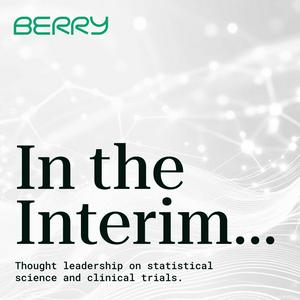
A podcast on statistical science and clinical trials. Explore the intricacies of Bayesian statistics and adaptive clinical trials. Uncover methods that push beyond conventional paradigms, ushering in data-driven insights that enhance trial outcomes while ensuring safety and efficacy. Join us as we dive into complex medical challenges and regulatory landscapes, offering innovative solutions tailored for pharma pioneers. Featuring expertise from industry leaders, each episode is crafted to provide clarity, foster debate, and challenge mainstream perspectives, ensuring you remain at the forefront of clinical trial excellence.
Strona internetowa podcastu

Słuchaj In the Interim..., Gutral Gada i wielu innych podcastów z całego świata dzięki aplikacji radio.pl

Uzyskaj bezpłatną aplikację radio.pl

  • Stacje i podcasty do zakładek
  • Strumieniuj przez Wi-Fi lub Bluetooth
  • Obsługuje Carplay & Android Auto
  • Jeszcze więcej funkcjonalności

In the Interim...: Podcasty w grupie

Media spoecznościowe
v8.7.2 | © 2007-2026 radio.de GmbH
Generated: 3/11/2026 - 9:09:26 AM